2.5 Warp Drive
Explains Voyager's warp engines: how warp speed is ordered and measured, the matter/antimatter power source, antimatter and dilithium crystals, the subspace field, variable geometry nacelles, and refueling.
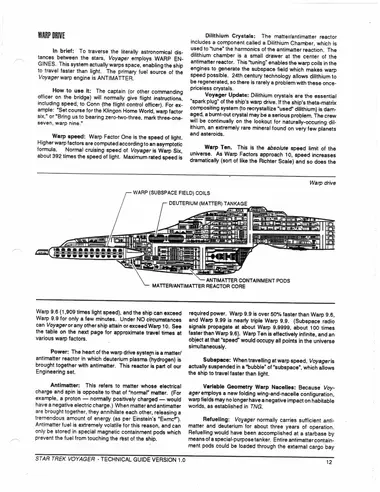
In brief: To traverse the literally astronomical distances between the stars, Voyager employs WARP ENGINES. This system actually propels the ship faster than light. The primary fuel source of the Voyager warp engine is ANTIMATTER.
How to use it: The Captain (or person commanding Voyager) will normally give flight instructions, including speed, to Conn (the flight control officer). For example: “Set course for the Klingon Home World, warp factor six.” or “Bring us to bearing zero-two-three, mark three-one-seven, warp nine.”
Warp speed: Warp Factor One is the speed of light. Normal cruising speed for Voyager is Warp Six, about 392 times the speed of light. Maximum rated speed is Warp 9.6 (1,909 times light speed), and the ship can exceed Warp 9.9 for only a few minutes. Under NO circumstances can Voyager or any other ship attain or exceed Warp 10. See the table on the next page for approximate travel times at various warp factors.
Power: The heart of the warp drive system is a matter/antimatter reactor in which deuterium plasma (hydrogen) is brought together with antimatter. This reactor is part of our Engineering set.
Antimatter: This refers to matter whose electrical charge and spin is opposite to that of “normal” matter. (For example, a proton — normally positively charged — would have a negative electric charge.) When matter and antimatter are brought together, they annihilate each other, releasing a tremendous amount of energy (as per Einstein’s “E=mc2”). Antimatter fuel is extremely volatile for this reason, and can only be stored in special magnetic containment pods which prevent the fuel from touching the rest of the ship.
Dilithium Crystals: The matter/antimatter reactor includes a component called a Dilithium Chamber, which is used to “tune” the harmonics of the antimatter reaction. The dilithium chamber is a small drawer at the center of the antimatter reactor. This “tuning” enables the warp coils in the engines to generate the subspace field which makes warp speed possible. 24th century technology allows dilithium to be regenerated, so there is rarely a problem with these once-priceless crystals.
Update: Dilithium crystals are the essential “spark plug” of the ship’s warp drive. If the ship’s theta-matrix compositing system (to recrystallize “used” dilithium) is damaged, a burnt-out crystal may be a serious problem. The crew is continually on the lookout for naturally-occurring dilithium, an extremely rare mineral found on very few planets and asteroids.
Warp Ten. This is the absolute speed limit of the universe. As Warp Factors approach 10, speed increases dramatically (sort of like the Richter Scale) and so does the required power. Warp 9.9 is over 50% faster than Warp 9.6, and Warp 9.99 is nearly triple Warp 9.9. (Subspace radio signals propagate at about Warp 9.9999, about 100 times faster than Warp 9.6). Warp Ten is effectively infinite, and an object at that “speed” would occupy all points in the universe simultaneously.
Subspace: When travelling at warp speed, Voyager is actually suspended in a “bubble” of “subspace”, which allows the ship to travel faster than light.
Variable Geometry Warp Nacelles: Because Voyager employs a new folding wing-and-nacelle configuration, warp fields may no longer have a negative impact on habitable worlds, as established in TNG.
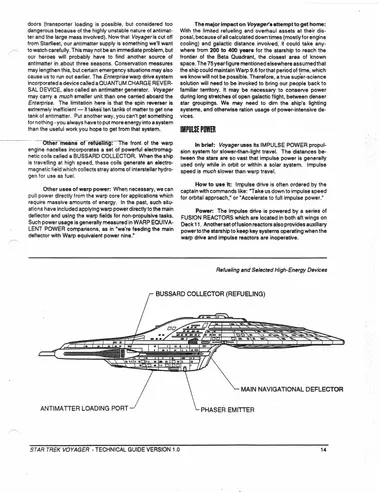
Refueling: Voyager normally carries sufficient antimatter and deuterium for about three years of operation. Refuelling would have been accomplished at a starbase by means of a special-purpose tanker. Entire antimatter containment pods could be loaded through the external cargo bay doors (transporter loading is possible, but considered too dangerous because of the highly unstable nature of antimatter and the large mass involved). Now that Voyager is cut off from Starfleet, our antimatter supply is something we’ll want to watch carefully. This may not be an immediate problem, but our heroes will probably have to find another source of antimatter in about three seasons. Conservation measures may lengthen this, but certain emergency situations may also cause us to run out earlier. The Enterprise warp drive system incorporated a device called a QUANTUM CHARGE REVERSAL DEVICE, also called an antimatter generator. Voyager may carry a much smaller unit than one carried aboard the Enterprise. The limitation here is that the spin reverser is extremely inefficient — it takes ten tanks of matter to get one tank of antimatter. Put another way, you can’t get something for nothing - you always have to put more energy into a system than the useful work you hope to get from that system.
Other means of refueling: The front of the warp engine nacelles incorporates a set of powerful electromagnetic coils called a BUSSARD COLLECTOR. When the ship is travelling at high speed, these coils generate an electromagnetic field which collects stray atoms of interstellar hydrogen for use as fuel.
Other uses of warp power: When necessary, we can pull power directly from the warp core for applications which require massive amounts of energy. In the past, such situations have included applying warp power directly to the main deflector and using the warp fields for non-propulsive tasks. Such power usage is generally measured in WARP EQUIVALENT POWER comparisons, as in “we’re feeding the main deflector with Warp equivalent power nine.”
The major impact on Voyager’s attempt to get home: With the limited refueling and overhaul assets at their disposal, because of all calculated down times (mostly for engine cooling) and galactic distance involved, it could take anywhere from 200 to 400 years for the starship to reach the frontier of the Beta Quadrant, the closest area of known space. The 75 year figure mentioned elsewhere assumed that the ship could maintain Warp 9.6 for that period of time, which we know will not be possible. Therefore, a true super-science solution will need to be invoked to bring our people back to familiar territory. It may be necessary to conserve power during long stretches of open galactic flight, between denser star groupings. We may need to dim the ship’s lighting systems, and otherwise ration usage of power-intensive devices.