2.22 Holodecks
Describes the holographic environment simulator: how it is used, its holographic imagery and matter conversion subsystems, animated characters, the reality of holodeck objects, location, and personal holodecks.
In brief: The HOLOGRAPHIC ENVIRONMENT SIMULATOR — pronounced by everyone as the holodeck — is a remarkable virtual reality entertainment and training exercise. It can recreate, with virtual fidelity, almost any environment in the computer’s memory. The ship’s computer holds a large selection of simulated environments which can be recreated at a moment’s notice.
How to use it: The holodeck is usually activated by the simple command “Activate the holodeck,” and the computer displays a menu of available simulations. The user will tell the computer which one he/she wants, as in “Load Altair IV program,” to which the computer would respond, “Program loaded, enter when ready.” When in the holodeck, a simulation can be halted by saying, “Freeze program.” If desired, one can also ask the computer to “save program” so that you can go back at a later time.
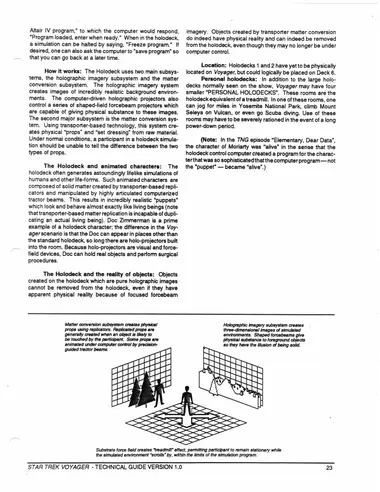
How it works: The Holodeck uses two main subsystems, the holographic imagery subsystem and the matter conversion subsystem. The holographic imagery system creates images of incredibly realistic background environments. The computer-driven holographic projectors also control a series of shaped-field forcebeam projectors which are capable of giving physical substance to these images. The second major subsystem is the matter conversion system. Using transporter-based technology, this system creates physical “props” and “set dressing” from raw material. Under normal conditions, a participant in a holodeck simulation should be unable to tell the difference between the two types of props.
The Holodeck and animated characters: The holodeck often generates astoundingly lifelike simulations of humans and other life-forms. Such animated characters are composed of solid matter created by transporter-based replicators and manipulated by highly articulated computerized tractor beams. This results in incredibly realistic “puppets” which look and behave almost exactly like living beings (note that transporter-based matter replication is incapable of duplicating an actual living being). Doc Zimmerman is a prime example of a holodeck character; the difference in the Voyager scenario is that the Doc can appear in places other than the standard holodeck, so long there are holo-projectors built into the room. Because holo-projectors are visual and forcefield devices, Doc can hold real objects and perform surgical procedures.
The Holodeck and the reality of objects: Objects created on the holodeck which are pure holographic images cannot be removed from the holodeck, even if they have apparent physical reality because of focused forcebeam imagery. Objects created by transporter matter conversion do indeed have physical reality and can indeed be removed from the holodeck, even though they may no longer be under computer control.
Location: Holodecks 1 and 2 have yet to be physically located on Voyager, but could logically be placed on Deck 6.
Personal holodecks: In addition to the large holodecks normally seen on the show, Voyager may have four smaller “PERSONAL HOLODECKS”. These rooms are the holodeck equivalent of a treadmill. In one of these rooms, one can jog for miles in Yosemite National Park, climb Mount Seleya on Vulcan, or even go scuba diving. Use of these rooms may have to be severely rationed in the event of a long power-down period.
(Note: In the TNG episode “Elementary, Dear Data”, the character of Moriarty was “alive” in the sense that the holodeck control computer created a program for the character that was so sophisticated that the computer program — not the “puppet” — became “alive”.)