2.7 Impulse Power
Describes Voyager's sublight impulse propulsion: how it is ordered, its fusion-reactor power and deuterium fuel, its speed, and conventions for stating sublight speeds and distances.
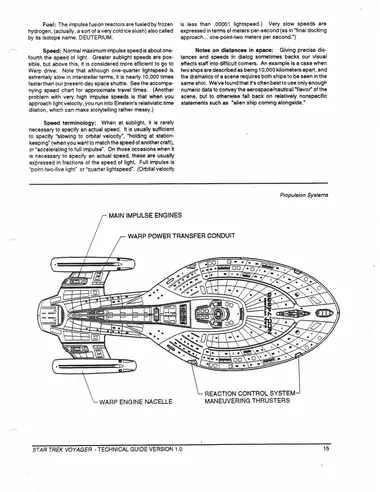
In brief: Voyager uses its IMPULSE POWER propulsion system for slower-than-light travel. The distances between the stars are so vast that impulse power is generally used only while in orbit or within a solar system. Impulse speed is much slower than warp travel.
How to use it: Impulse drive is often ordered by the captain with commands like: “Take us down to impulse speed for orbital approach,” or “Accelerate to full impulse power.”
Power: The impulse drive is powered by a series of FUSION REACTORS which are located in both aft wings on Deck 11. Another set of fusion reactors also provides auxiliary power to the starship to keep key systems operating when the warp drive and impulse reactors are inoperative.
Fuel: The impulse fusion reactors are fueled by frozen hydrogen, (actually, a sort of a very cold ice slush) also called by its isotope name, DEUTERIUM.
Speed: Normal maximum impulse speed is about one-fourth the speed of light. Greater sublight speeds are possible, but above this, it is considered more efficient to go to Warp drive. Note that although one-quarter lightspeed is extremely slow in interstellar terms, it is nearly 10,000 times faster than our present-day space shuttle. See the accompanying speed chart for approximate travel times. (Another problem with very high impulse speeds is that when you approach light velocity, you run into Einstein’s relativistic time dilation, which can make storytelling rather messy.)
Speed terminology: When at sublight, it is rarely necessary to specify an actual speed. It is usually sufficient to specify “slowing to orbital velocity”, “holding at station-keeping” (when you want to match the speed of another craft), or “accelerating to full impulse”. On those occasions when it is necessary to specify an actual speed, these are usually expressed in fractions of the speed of light. Full impulse is “point-two-five light” or “quarter lightspeed”. (Orbital velocity is less than .00001 lightspeed.) Very slow speeds are expressed in terms of meters-per-second (as in “final docking approach... one-point-two meters per second.”)
Notes on distances in space: Giving precise distances and speeds in dialog sometimes backs our visual effects staff into difficult corners. An example is a case when two ships are described as being 10,000 kilometers apart, and the dramatics of a scene requires both ships to be seen in the same shot. We’ve found that it’s often best to use only enough numeric data to convey the aerospace/nautical “flavor” of the scene, but to otherwise fall back on relatively nonspecific statements such as “alien ship coming alongside.”