An alphabetical glossary of basic Star Trek: Voyager technical terms, races, and ship systems, presented as a quick reference for writers.
A quick alphabetical reference to basic Trektech. More detail on these subjects is available in the following sections, but in most cases, this is all you really need. Remember, this stuff is presented here in case you need it, but many of our best stories have used very little technical dialog, and the writer should not feel obligated to use all (or any) of this stuff. Some terms and alien races are holdovers from The Next Generation; they are useful as background information.
Antimatter
Matter which is exactly the same as normal matter, but with the opposite spin and electrical charge. When matter and antimatter come into contact with each other, both are annihilated with a tremendous release of energy. Antimatter is the primary power source of our ship's warp drive.
Bearings
A term used to describe directions in space. It is usually used in the form: “The unknown spacecraft is at bearing zero-two-five, mark one-five.”
Biofilter
A device built into the transporter which scans for, and filters out many kinds of known hazardous bacteria and viruses. It is not effective against organisms for which it has not been programmed.
Borg
One of the most dangerous entities in the Galaxy. The Borg is a collection of many life forms, joined by cybernetic implants to form a single group mind. The concept of the individual is alien to the Borg. As Voyager has been thrown into the Delta
Quadrant, the home of the Borg, it is possible we will encounter them during the series.
Bridge
The command center from which the captain controls the operation of Voyager. The main bridge is the prominent feature at the top of the ship's primary hull.
Cloaking Device
A mechanism which permits Romulan and Klingon starships to render themselves virtually invisible. A ship is not capable of firing its weapons while cloaked. Until
DS9 acquired the USS Defiant, Federation starships did not have cloaking devices.
Communicator
A tiny personal communications device worn as an emblem on Starfleet uniforms. This device lets our people talk to the ship when on an Away mission, and talk to each other when on Voyager, something like a voice-activated cellular phone.
Computer
The Voyager main computer is tremendously powerful and very easy to use. In most cases, you can just verbally ask it a question, and it will either give you an answer in its spoken computer voice, or it will help you to clarify your question so that it can find the answer. The actual main computer hardware is located in two computer cores located in the bowels of the ship.
Conn
Short for “flight controller.” This is Tom Paris' control station on the bridge, directly in front of the captain Janeway's chair. Conn is responsible for actually flying the ship, fulfilling both helm and navigation functions.
Deflectors
Also called navigational deflectors. A focused invisible force field which protects Voyager against natural hazards in space; can be modified for use against hostile attack.
Deuterium
An isotope of hydrogen used as the primary fuel for both the warp and impulse engines. It is stored in a frozen “slush” state in large onboard tanks.
Diagnostics
Pre-programmed troubleshooting procedures used to troubleshoot most ship's systems. When you want a through (but time-consuming) analysis, you ask for a “level one diagnostic.” When faster (but less through) analyses are called for, “level two” through “level five diagnostics” are usually ordered. (Five being the fastest.)
Dilithium Crystals
The heart of our warp drive system, dilithium crystals control the powerful matter/antimatter reaction which permits our ship to travel faster than light.
Disruptors
Powerful energy weapons which are the principal weaponry of the Klingons and Romulans. (Klingons and Romulans do not normally use phasers.) Other alien weapon types will undoubtedly be invented for Star Trek: Voyager.
Federation
The
United Federation of Planets represents perhaps 150 different planets and colonies, of which Earth is one.
Federation Council
The United Federation of Planets is governed by the Federation Council, presumably composed of representatives of the member planets. The Council is led by a president.
Ferengi
The Ferengi are capitalistic in the extreme. Although they follow their own strict code of ethics, to an outsider this behavior can often seem sinister and underhanded.
Galaxy
The Earth is located in the Milky Way Galaxy, a spiral-shaped group of about 100 billion stars. Voyager can explore only one tiny part of the Milky Way. There are many other galaxies in the universe, but they are so far away that even a nearby galaxy would take over a thousand years to reach at maximum warp.
Hailing Frequencies
Part of standard radio procedures when communicating with other Federation ships and planets. One will normally open hailing frequencies when attempting to establish a radio communications link.
Headings
A term used to describe directions in space. It is usually used in the form: “Set a course for the Klingon Home World, heading two-six-five, mark three-two.”
Holodeck
One of two large rooms on Voyager which uses sophisticated computer imagery to create incredible simulations of any environment in the computer's memory. Very popular for recreation as well as crew training.
Impulse Drive
The secondary propulsion system of Voyager, used for slower-than-light travel. Much slower than warp drive, impulse speed is normally used only within a solar system or in orbit around a planet.
Isolinear Chips
Small rectangles of colored plastic which are used to store information, much like we use computer disks today. On Voyager, isolinear chips will be augmented by neural gel-pack computer circuits.
Jefferies Tubes
Maintenance crawlways interspersed about Voyager, providing access to power, computer, environmental, and other equipment. Jefferies Tubes run both horizontally and vertically within the starship.
Kazon
A race of unpleasant rogues divided into two competing sects, the Kazon-Ogla and the Kazon-Sera, bent on pursuing Voyager for its technology.
Klingon Empire
The historic enemies of the Federation, now our allies through an uneasy alliance. The Klingon national character is highly aggressive, but with great emphasis on their traditional sense of honor and duty. The capital of the Klingon Empire is the planet Q'onoS (pronounced “kronos”), although Klingons almost invariably refer to it as “the Home World.” The empire is governed by the Klingon High Council. B'Elanna Torres is half Klingon.
Lifeboats
Voyager has thirty-six lifeboat (escape) pods which can be ejected in extreme emergency. Each pod can hold up to six people comfortably.
Moon
A small planet or asteroid which orbits a larger planet, much like our moon orbits the Earth.
Nebula
A very thin cloud of dust and gas in space.
Neural Gel-Packs
An advanced type of fast computer circuitry which utilizes synthetic neural tissue to organize and process data more efficiently than standard isolinear chips. Gel-packs act as the “head end” of many computer devices aboard Voyager.
Nova
A star which, from natural causes, experiences a sudden increase in brightness. Stars experiencing an explosive increase are called supernovas.
Ops
Short for “Operations Officer.” This is a control station on the bridge, to the port side rear of the captain's chair. Ops is responsible for coordinating the activities of the ship's many departments.
PADD
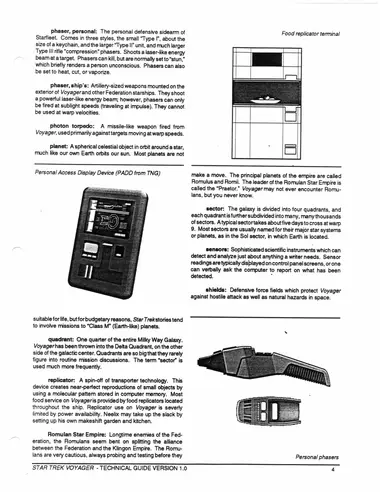
Personal Access Display Device. A small handheld gizmo used aboard Voyager for information access and display.
Phaser, Personal
The personal defensive sidearm of Starfleet. Comes in three styles, the small “Type I”, about the size of a keychain, and the larger “Type II” unit, and much larger Type III rifle “compression” phasers. Shoots a laser-like energy beam at a target.
Phasers can kill, but are normally set to “stun,” which briefly renders a person unconscious. Phasers can also be set to heat, cut, or vaporize.
Phaser, Ship's
Artillery-sized weapons mounted on the exterior of Voyager and other Federation starships. They shoot a powerful laser-like energy beam; however, phasers can only be fired at sublight speeds (traveling at impulse). They cannot be used at warp velocities.
Photon Torpedo
A missile-like weapon fired from Voyager, used primarily against targets moving at warp speeds.
Planet
A spherical celestial object in orbit around a star, much like our own Earth orbits our sun. Most planets are not suitable for life, but for budgetary reasons, Star Trek stories tend to involve missions to “
Class M” (Earth-like) planets.
Quadrant
One quarter of the entire Milky Way Galaxy. Voyager has been thrown into the Delta Quadrant, on the other side of the galactic center. Quadrants are so big that they rarely figure into routine mission discussions. The term “sector” is used much more frequently.
Replicator
A spin-off of transporter technology. This device creates near-perfect reproductions of small objects by using a molecular pattern stored in computer memory. Most food service on Voyager is provided by food replicators located throughout the ship. Replicator use on Voyager is severely limited by power availability. Neelix may take up the slack by setting up his own makeshift garden and kitchen.
Romulan Star Empire
Longtime enemies of the Federation, the Romulans seem bent on splitting the alliance between the Federation and the Klingon Empire. The Romulans are very cautious, always probing and testing before they make a move. The principal planets of the empire are called Romulus and Remus. The leader of the Romulan Star Empire is called the “Praetor.” Voyager may not ever encounter Romulans, but you never know.
Sector
The galaxy is divided into four quadrants, and each quadrant is further subdivided into many, many thousands of sectors. A typical sector takes about five days to cross at warp 9. Most sectors are usually named for their major star systems or planets, as in the Sol sector, in which Earth is located.
Sensors
Sophisticated scientific instruments which can detect and analyze just about anything a writer needs. Sensor readings are typically displayed on control panel screens, or one can verbally ask the computer to report on what has been detected.
Shields
Defensive force fields which protect Voyager against hostile attack as well as natural hazards in space.
Shuttlebay
The large facility at the aft end of Voyager used for shuttle launches and recovery.
Shuttlecraft
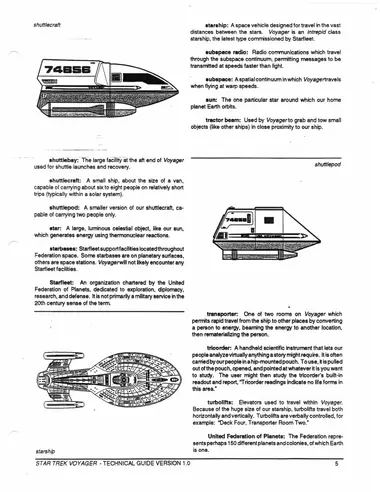
A small ship, about the size of a van, capable of carrying about six to eight people on relatively short trips (typically within a solar system).
Shuttlepod
A smaller version of our shuttlecraft, capable of carrying two people only.
Star
A large, luminous celestial object, like our sun, which generates energy using thermonuclear reactions.
Starbases
Starfleet support facilities located throughout Federation space. Some starbases are on planetary surfaces, others are space stations. Voyager will not likely encounter any Starfleet facilities.
Starfleet
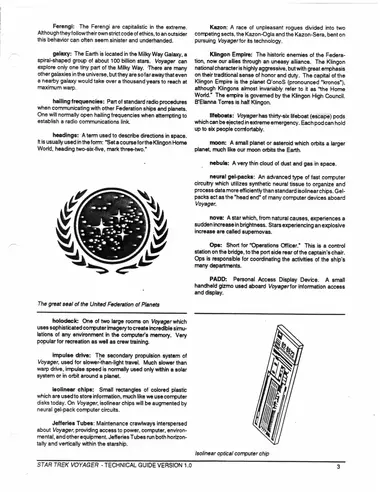
An organization chartered by the United Federation of Planets, dedicated to exploration, diplomacy, research, and defense. It is not primarily a military service in the 20th century sense of the term.
Starship
A space vehicle designed for travel in the vast distances between the stars. Voyager is an Intrepid class starship, the latest type commissioned by Starfleet.
Subspace
A spatial continuum in which Voyager travels when flying at warp speeds.
Subspace Radio
Radio communications which travel through the subspace continuum, permitting messages to be transmitted at speeds faster than light.
Sun
The one particular star around which our home planet Earth orbits.
Tractor Beam
Used by Voyager to grab and tow small objects (like other ships) in close proximity to our ship.
Transporter
One of two rooms on Voyager which permits rapid travel from the ship to other places by converting a person to energy, beaming the energy to another location, then rematerializing the person.
Tricorder
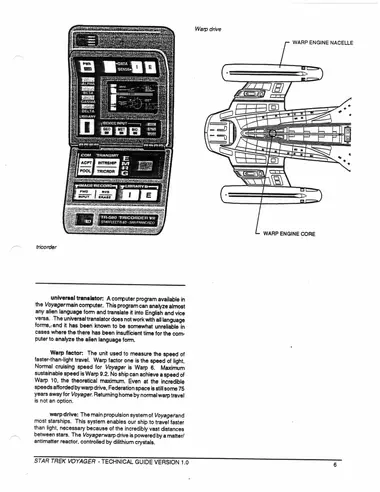
A handheld scientific instrument that lets our people analyze virtually anything a story might require. It is often carried by our people in a hip-mounted pouch. To use, it is pulled out of the pouch, opened, and pointed at whatever it is you want to study. The user might then study the tricorder's built-in readout and report, “Tricorder readings indicate no life forms in this area.”
Turbolifts
Elevators used to travel within Voyager. Because of the huge size of our starship, turbolifts travel both horizontally and vertically. Turbolifts are verbally controlled, for example: “Deck Four, Transporter Room Two.”
United Federation of Planets
The Federation represents perhaps 150 different planets and colonies, of which Earth is one.
Universal Translator
A computer program available in the Voyager main computer. This program can analyze almost any alien language form and translate it into English and vice versa. The universal translator does not work with all language forms, and it has been known to be somewhat unreliable in cases where there has been insufficient time for the computer to analyze the alien language form.
Warp Factor
The unit used to measure the speed of faster-than-light travel. Warp factor one is the speed of light. Normal cruising speed for Voyager is Warp 6. Maximum sustainable speed is Warp 9.2. No ship can achieve a speed of Warp 10, the theoretical maximum. Even at the incredible speeds afforded by warp drive, Federation space is still some 75 years away for Voyager. Returning home by normal warp travel is not an option.
Warp Drive
The main propulsion system of Voyager and most starships. This system enables our ship to travel faster than light, necessary because of the incredibly vast distances between stars. The Voyager warp drive is powered by a matter/antimatter reactor, controlled by dilithium crystals.