2.33 Spaceflight and the Galaxy
Covers spaceflight conventions and galactic geography: standard orbit, warp drive, courses and directions, bearing versus heading, distances in maneuvers, sectors and their names, quadrants, galactic coordinates, and starbases.
Standard orbit: When Voyager orbits a planet, it generally assumes what is called STANDARD ORBIT. For a Class M (Earth-like) planet, this is often a synchronous orbit at about 35,000 kilometers altitude.
Warp drive: The distances between the stars are so vast that the ship is normally under warp drive except when in orbit or when it is within a solar system. By comparison, impulse speed represents a virtual standstill.
Courses and directions: Most times when the Captain specifies a course for the ship or a direction in space, it should be in the form: “Unidentified spacecraft at bearing 104, mark 12”, where both numbers are measurements in degrees (which means that both numbers should be less than 360). Other forms used when setting courses include specifying sectors, or just the name of the destination planet.
For the truly curious: The term “bearing” (as in Bearing 270, mark 47) refers to two angles measured relative to Voyager. (Bearing 000, Mark 0 is straight ahead.) The term “heading” (as in Heading 270, mark 47) refers to angles measured relative to the galaxy itself. Imagine you’re driving a car and think of “bearing 090” as turning right (relative to the car), but “heading 090” would be turn west (relative to the Earth). Put another way, you would generally specify a heading when you’re setting out on a new trip, but then use a bearing to specify a course correction relative to the original heading. If this is confusing, don’t worry, you’re usually safe if you just use “bearings”.
A note on distances in spaceflight maneuvers: Giving precise distances and speeds to other spacecraft in dialog usually sounds good, but can sometimes create problems for our visual effects staff. It may be technically correct to have a character say, “Alien spacecraft closing to 5,000 kilometers.” In terms of actual spaceflight, this is pretty close, but this makes it difficult if we need a scene in which Voyager is seen in the same shot with this other ship. In such cases, it is often better to avoid giving specific distances, speeds, or positions. An example might be to just say, “Alien spacecraft now approaching, dead slow.”
Sectors: The primary unit of measure in known space is the SECTOR. Each sector is about 20 light-years across and typically contains perhaps a half-dozen solar systems. A starship travelling at Warp Six takes about 19 days to cross a sector. At maximum warp (9.6) it takes about 4 days.
Sector numbers and names: Sectors are properly known by a three-to-six digit number (i.e. Sector 18834), but many sectors have common names for their major star systems or planets. For example, the Earth is located in Sector 001, also known as the Sol Sector, and Starbase 515 was located in the Scylla Sector.
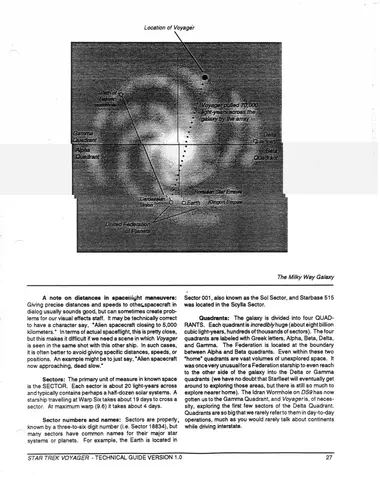
Quadrants: The galaxy is divided into four QUADRANTS. Each quadrant is incredibly huge (about eight billion cubic light-years, hundreds of thousands of sectors). The four quadrants are labeled with Greek letters, Alpha, Beta, Delta, and Gamma. The Federation is located at the boundary between Alpha and Beta quadrants. Even within these two “home” quadrants are vast volumes of unexplored space. It was once very unusual for a Federation starship to even reach to the other side of the galaxy into the Delta or Gamma quadrants (we have no doubt that Starfleet will eventually get around to exploring those areas, but there is still so much to explore nearer home). The Idran Wormhole on DS9 has now gotten us to the Gamma Quadrant, and Voyager is, of necessity, exploring the first few sectors of the Delta Quadrant. Quadrants are so big that we rarely refer to them in day-to-day operations, much as you would rarely talk about continents while driving interstate.
Galactic coordinates: When specifying travel destinations for Voyager, it is occasionally appropriate to give GALACTIC COORDINATES. These are generally given in a set of three numbers, such as “Set course for galactic coordinates 394345 by 885354 by 032234.” (Note that the galaxy is such a huge place that these numbers are fairly imprecise, sort of like specifying a ZIP code but not the street address.) In most cases it will be easier and more understandable to simply specify the destination sector (“Set course for the Orion Sector”) or even just the direction of flight (“Set course 312, mark 57”).
Starbases: Starfleet Command maintains a network of a little over five hundred support and operations facilities throughout Federation space, some on the surfaces of planets, while others are space stations. A starbase is generally the next-higher authority in the Starfleet chain-of-command over a starship captain. Starships often operate past the frontier of Federation space, and it is not uncommon for them to be weeks out of touch with any starbase, even by subspace radio.
Note: For estimated travel times at various warp factors, see the Warp Speed chart on p. 13.