6.2 Canopus to Elba
The catalog continues through Canopus, Capella, Cestus, Coridan, the Cygnet system, and on through the D and E entries to Eden, Eminiar, Excalbia, and Elba.
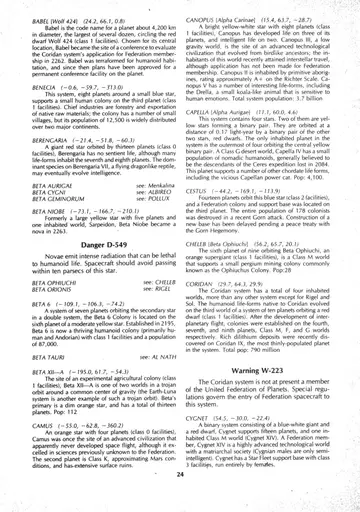
Canopus [Alpha Carinae] (15.4, 63.7, -28.7)
A bright yellow-white star with eight planets (class 1 facilities), Canopus has developed life on three of its planets, and intelligent life on two. Canopus III, a low gravity world, is the site of an advanced technological civilization that evolved from birdlike ancestors; the inhabitants of this world recently attained interstellar travel, although application has not been made for Federation membership. Canopus II is inhabited by primitive aborigines, rating approximately A+ on the Richter Scale. Canopus V has a number of interesting life-forms, including the Drella, a small koala-like animal that is sensitive to human emotions. Total system population: 3.7 billion
Capella [Alpha Aurigae] (11.1, 60.0, 4.6)
This system contains four stars. Two of them are yellow stars forming a binary pair. They are orbited at a distance of 0.17 light-year by a binary pair of the other two stars, red dwarfs. The only inhabited planet in the system is the outermost of four orbiting the central yellow binary pair. A Class G desert world, Capella IV has a small population of nomadic humanoids, generally believed to be the descendants of the Ceres expedition lost in 2084. This planet supports a number of other chordate life forms, including the vicious Capellan power cat. Pop: 4,100.
Cestus (-44.2, -169.1, -113.9)
Fourteen planets orbit this blue star (class 2 facilities), and a Federation colony and support base was located on the third planet. The entire population of 178 colonists was destroyed in a recent Gorn attack. Construction of a new base has been delayed pending a peace treaty with the Gorn Hegemony.
Cheleb [Beta Ophiuchi] (56.2, 65.7, 20.1)
The sixth planet of nine orbiting Beta Ophiuchi, an orange supergiant (class 1 facilities), is a Class M world that supports a small pergium mining colony commonly known as the Ophiuchus Colony. Pop: 28
Coridan (29.7, 64.3, 29.9)
The Coridan system has a total of four inhabited worlds, more than any other system except for Rigel and Sol. The humanoid life-forms native to Coridan evolved on the third world of a system of ten planets orbiting a red dwarf (class 1 facilities). After the development of interplanetary flight, colonies were established on the fourth, seventh, and ninth planets, Class M, F, and G worlds respectively. Rich dilithium deposits were recently discovered on Coridan IX, the most thinly-populated planet in the system. Total pop: 790 million
Warning W-223. The Coridan system is not at present a member of the United Federation of Planets. Special regulations govern the entry of Federation spacecraft to this system.
Cygnet (54.5, -30.0, -22.4)
A binary system consisting of a blue-white giant and a red dwarf, Cygnet supports fifteen planets, and one inhabited Class M world (Cygnet XIV). A Federation member, Cygnet XIV is a highly advanced technological world with a matriarchal society (Cygnian males are only semi-intelligent). Cygnet has a Star Fleet support base with class 3 facilities, run entirely by females.
Cygnia Minor see: Albireo
Daran (-127.5, -139.2, -19.7)
A moderate orange star orbited by ten planets (class 3 facilities), Daran is a Federation member with a humanoid population of 3.7 billion on the fifth planet. Originally an Earth colony, Daran has a large Deltan and Tellarite population as well, and is a major industrial center in a relatively unpopulated quadrant.
Delta Dorado see: Gideon
Delta Vega (140.9, 47.7, 187.8)
A white dwarf on the northern fringe of the galaxy, Delta Vega has only one planet, a Class F world with only primitive life and a primordial atmosphere. An automated dilithium cracking station is located on this world, and ore ships call only once every twenty years; the system has class 1 facilities that are totally automatic.
Deneb [Alpha Cygni] (142.7, -143.4, 382.5)
A major star system with a population of over 29 billion, Deneb ranks with Sol and Rigel as one of the major cultural centers of the Federation, and its location above the galactic ecliptic makes it one of the most remote of Federation members. A system of five planets orbiting a white supergiant in a binary system (class 4 facilities), planets II, IV, and V are Class M and support intelligent life. Deneb II is Class N, and has several interesting non-sapient life-forms. Deneb II has an advanced native population with a population of about 1.8 billion, and is on the verge of interstellar flight, with a Richter rating of G-. Deneb IV has a small Federation colony (Pop. 17,000) and supply base, but is largely unspoiled wilderness. Deneb V is the most heavily populated world in the system, and is a major Federation port with a Star Fleet training center, extensive naval yards, and the newly-opened Academy of Sciences. Originally a colony of Deneb II, it still supports a large Denebian population.
Deneva (45.8, 52.8, 96.9)
The third planet of seven orbiting a moderate white star, Deneva was colonized in the 2160's as a trading base between the mineral-rich Denevan asteroid belts and the Federation industrial worlds. It now has a human population of over 1 million, mostly centered around the port city of New Sacramento, and is still the home system of several interstellar freight lines (class 2 facilities).
Dimorus (-26.7, -18.8, -27.9)
The fourth planet of eight orbiting a pair of moderate orange stars (class 0 facilities), Dimorus has a native population of intelligent rodent-like creatures which rate about C- on the Richter Scale. Extreme xenophobes, they have attacked several Federation contact teams, and the planet has been placed under quarantine until further notice.
Eden (-146.6, -190.1, 2.8)
Originally a world of mythical beauty described by shipwrecked survivors of the Romulan War in the 2160's, Eden was recently identified as the only planet of a moderate white star (UFC 3676543) with class 0 facilities in the Romulan Neutral Zone. It has no animal life, and the native flora has been found to contain extremely corrosive acid.
Prohibited P-091. Entry into the neutral zone by any Federation vessel is a violation of interstellar treaty, and is expressly forbidden.
Elba (-18.3, -119.4, -7.1)
A white dwarf binary with two planets (class 1 facilities), the Elba correctional facility for the incurably insane is located on the second planet. Since the planet is Class F with a poisonous atmosphere, the facility is located inside a pressure dome. Current population of staff and inmates: 78
Prohibited P-137. Elba is a restricted area, and only authorized spacecraft are permitted to enter this system.
Eminiar (-37.0, 222.3, 25.1)
A large yellow star in a dense stellar cluster, Eminiar has eleven planets, two of which are inhabited: Eminiar III (Vendikar) and Eminiar VII. Both have a very advanced humanoid civilization, which evolved originally on the seventh planet and later colonized Vendikar. The inhabitants of this system recently ended a five-century-long interplanetary war, and are currently negotiating a trade agreement with the Federation. Class 3 approach facilities are being installed.
Epsilon Bootis see: Izar
Epsilon Canaris see: Adhara
Epsilon Indi see: Andor
40 Serpentis see: Tung Hae
Eta Serpentis (40.8, 61.6, 7.2)
Colony Terra Five (class 2 facilities) is located on the sixth planet in this system of eight planets orbiting a moderate size yellow star. Established in 2170, the colony now supports a thriving population of 850,000 and has several large cities and universities, as well as a Star Fleet support base.
Excalbia (-54.8, -157.7, -193.4)
The first of three planets orbiting a blue-white giant (class 0 facilities), Excalbia is Class D with a surface of molten lava. The inhabitants of Excalbia are intelligent carbon-cycle beings with a chemistry based on calcium carbonate. Contact with these entities is limited to authorized contact teams.
Exo (52.2, 74.1, 70.6)
This system consists of four planets orbiting a small red star which has begun to contract due to helium burning within the last 30,000 years. The third planet, at one time Class M and inhabited by a vaguely humanoid race, is now uninhabitable, with a mean surface temperature of -50°C; extensive ruins beneath the glaciated surface suggest an advanced civilization that never developed space flight.
Farina (-126.1, -144.7, -7.8)
Formerly a moderate size yellow star with eight planets, including one inhabited Class M world. It became a nova 10,000 years ago, and is now the site of a neutron star and an expanding nebula. The only known survivors are the inhabitants of Yonada, a multi-generational asteroid starship.
40 Eridani (19.5, 60.0, -0.6)
A triple star system composed of a large orange star and two dwarf companions, the 40 Eridani system has two planets, both circling the orange primary. The first planet is Vulcan, a large, Class M world with a high surface gravity and temperature, the home world of an advanced and highly intelligent civilization that predates mankind