2.1 Coordinate Geometry
Space is a three-dimensional medium located by a rectangular system of three perpendicular axes (X, Y, Z), with bearings given as elevation and azimuth angles in a spherical system.
This section contains background material on coordinate geometry, and may be skipped if the reader is already familiar with this subject. It is recommended, however, that this section be read as a “refresher course.”
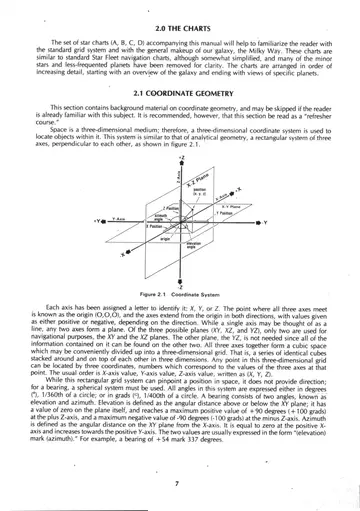
Space is a three-dimensional medium; therefore, a three-dimensional coordinate system is used to locate objects within it. This system is similar to that of analytical geometry, a rectangular system of three axes, perpendicular to each other, as shown in figure 2.1.
Each axis has been assigned a letter to identify it: X, Y, or Z. The point where all three axes meet is known as the origin (0,0,0), and the axes extend from the origin in both directions, with values given as either positive or negative, depending on the direction. While a single axis may be thought of as a line, any two axes form a plane. Of the three possible planes (XY, XZ, and YZ), only two are used for navigational purposes, the XY and the XZ planes. The other plane, the YZ, is not needed since all of the information contained on it can be found on the other two. All three axes together form a cubic space which may be conveniently divided up into a three-dimensional grid. That is, a series of identical cubes stacked around and on top of each other in three dimensions. Any point in this three-dimensional grid can be located by three coordinates, numbers which correspond to the values of the three axes at that point. The usual order is X-axis value, Y-axis value, Z-axis value, written as (X, Y, Z).
While this rectangular grid system can pinpoint a position in space, it does not provide direction; for a bearing, a spherical system must be used. All angles in this system are expressed either in degrees (°), 1/360th of a circle; or in grads (g), 1/400th of a circle. A bearing consists of two angles, known as elevation and azimuth. Elevation is defined as the angular distance above or below the XY plane; it has a value of zero on the plane itself, and reaches a maximum positive value of +90 degrees (+100 grads) at the plus Z-axis, and a maximum negative value of -90 degrees (-100 grads) at the minus Z-axis. Azimuth is defined as the angular distance on the XY plane from the X-axis. It is equal to zero at the positive X-axis and increases towards the positive Y-axis. The two values are usually expressed in the form “(elevation) mark (azimuth).” For example, a bearing of +54 mark 337 degrees.