1.4 Warp Speeds and Corrected Warp Speed Table
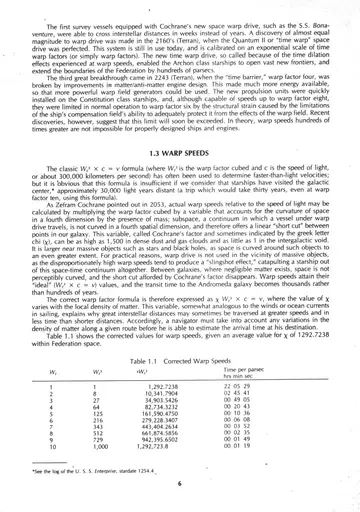
This section explains why the classic warp formula is insufficient and introduces Cochrane's factor (chi), which corrects warp velocity for the local density of matter, and presents Table 1.1 of corrected warp speeds and transit times per parsec within Federation space.
The section notes that the classic formula Wf3 × c = v (warp factor cubed times the speed of light, about 300,000 km/s) has been used for faster-than-light velocities but is clearly inadequate — for example, it would imply a thirty-year trip even at warp ten to the galactic center, roughly 30,000 light years away, which starships have nonetheless visited.
It explains that, as Zefram Cochrane noted in 2053, true warp speed is found by multiplying the warp factor cubed by a variable accounting for the curvature of space in a fourth dimension due to mass. Subspace, the continuum a warp-driven vessel travels through, is not curved in this way and so offers a linear short cut between points in the galaxy. This variable, Cochrane's factor (the Greek letter chi, χ), ranges from as high as 1,500 in dense dust and gas clouds to as little as 1 in the intergalactic void, and is larger near massive objects such as stars and black holes. For that reason warp drive is avoided near massive objects, where disproportionately high speeds can cause a slingshot effect that flings a ship out of the space-time continuum.
It adds that between galaxies, with negligible matter, space is barely curved and the short cut vanishes, so warp speeds approach their ideal values and intergalactic transit times become very long. The corrected formula is therefore χWf3 × c = v, where χ varies with the local density of matter — an effect compared to winds or ocean currents in sailing that explains why some long interstellar distances can be crossed faster than shorter ones, so a navigator must account for matter density along a route when estimating arrival time.
The section introduces Table 1.1, giving corrected warp speeds for an average Cochrane's factor of 1292.7238 within Federation space. The table lists, for each warp factor, the warp factor cubed, the corrected warp speed (χWf3), and the time per parsec:
- Warp 1 — 1 — 1,292.7238 — 22 05 29
- Warp 2 — 8 — 10,341.7904 — 02 45 41
- Warp 3 — 27 — 34,903.5426 — 00 49 05
- Warp 4 — 64 — 82,734.3232 — 00 20 43
- Warp 5 — 125 — 161,590.4750 — 00 10 36
- Warp 6 — 216 — 279,228.3407 — 00 06 08
- Warp 7 — 343 — 443,404.2634 — 00 03 52
- Warp 8 — 512 — 661,874.5856 — 00 02 35
- Warp 9 — 729 — 942,395.6502 — 00 01 49
- Warp 10 — 1,000 — 1,292,723.8 — 00 01 19
A footnote refers the reader to the log of the U.S.S. Enterprise, stardate 1254.4.