Writers' Manual · Visual Records
Technical Schematics
40 figures and diagrams. Select any plate to enlarge.
Figures
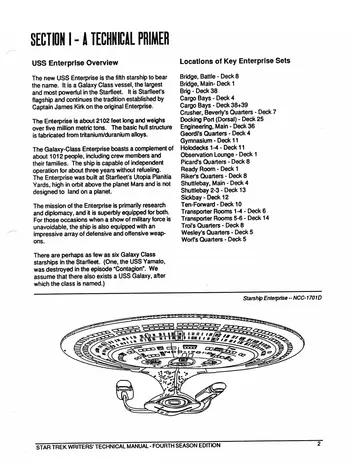
Starship Enterprise -- NCC-1701-D (top-view line drawing of the Galaxy Class USS Enterprise)
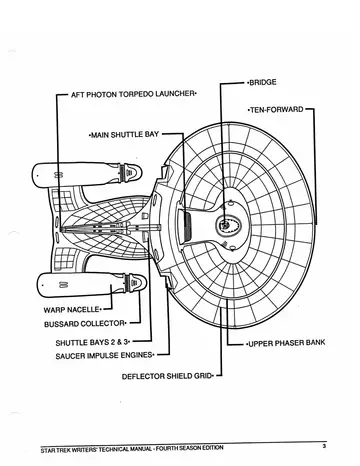
Top-view cutaway diagram of the USS Enterprise with callouts: Bridge, Ten-Forward, Aft Photon Torpedo Launcher, Main Shuttle Bay, Warp Nacelle, Bussard Collector, Shuttle Bays 2 & 3, Saucer Impulse Engines, Deflector Shield Grid, and Upper Phaser Bank.
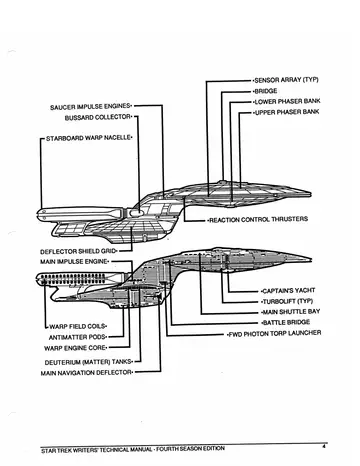
Side-view diagrams of the saucer (primary hull) and engineering (battle) section with callouts: Sensor Array (typ), Bridge, Lower Phaser Bank, Upper Phaser Bank, Saucer Impulse Engines, Bussard Collector, Starboard Warp Nacelle, Reaction Control Thrusters, Deflector Shield Grid, Main Impulse Engine, Captain's Yacht, Turbolift (typ), Main Shuttle Bay, Battle Bridge, Fwd Photon Torp Launcher, Warp Field Coils, Antimatter Pods, Warp Engine Core, Deuterium (Matter) Tanks, and Main Navigation Deflector.
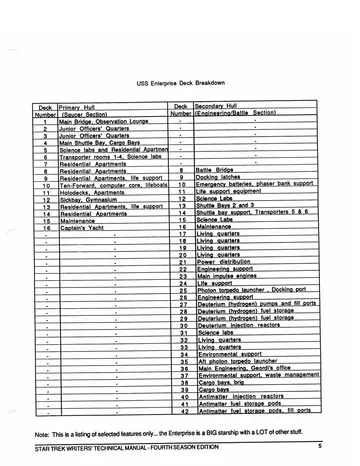
USS Enterprise Deck Breakdown — two-column table of selected features by deck for the Primary Hull (Saucer Section) and the Secondary Hull (Engineering/Battle Section).
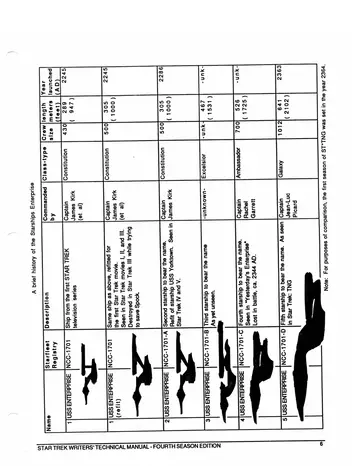
A brief history of the Starships Enterprise — table comparing the five Enterprises (NCC-1701 through NCC-1701-D) with silhouette drawings of each ship and columns for registry, description, commander, class-type, crew size, length, and year launched.
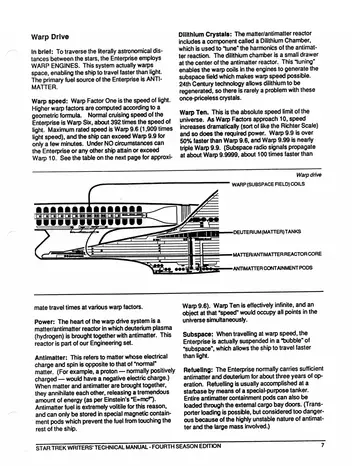
Warp drive — cutaway diagram of the warp propulsion system with callouts: Warp (Subspace Field) Coils, Deuterium (Matter) Tanks, Matter/Antimatter Reactor Core, and Antimatter Containment Pods.
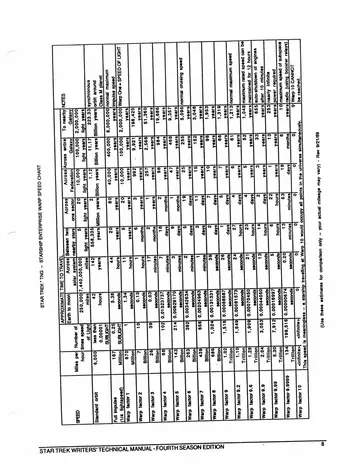
Star Trek: The Next Generation Enterprise Warp Speed Chart — table of warp factors with their speed (in multiples of light speed) and approximate travel times across representative distances.
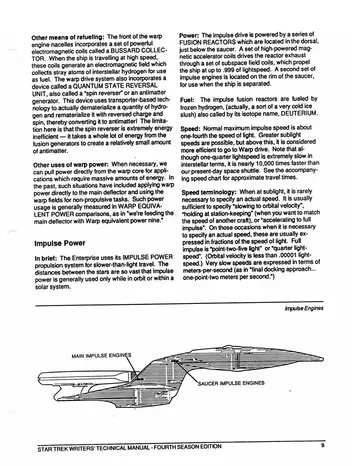
Impulse Engines — diagram showing the Main Impulse Engines and the Saucer Impulse Engines.
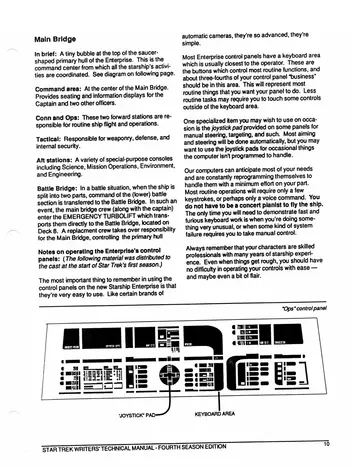
“Ops” control panel — diagram of an Ops console identifying the Joystick Pad and the Keyboard Area.
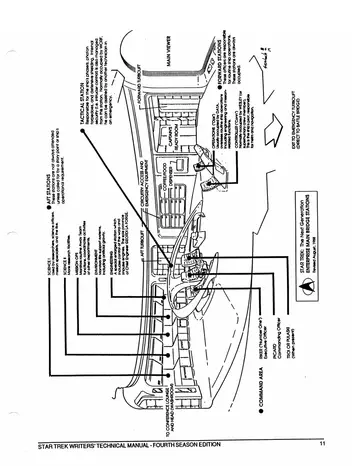
Cutaway diagram of the Main Bridge with callouts including the Command Area, Captain (Command Chair), Conn and Ops, Tactical Station, Aft Stations, Main Viewer, and the Emergency Turbolift to the Battle Bridge.
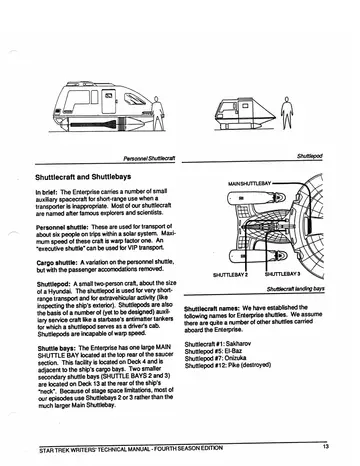
Personnel Shuttlecraft and Shuttlepod — line drawings of the two auxiliary craft types.
Shuttlecraft landing bays — diagram of the Main Shuttle Bay and Shuttlebays 2 and 3.
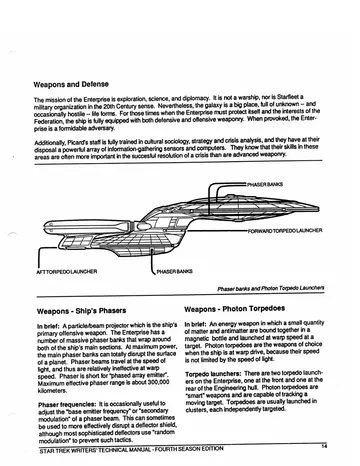
Phaser banks and Photon Torpedo Launchers — diagram identifying the Phaser Banks, Forward Torpedo Launcher, and Aft Torpedo Launcher.
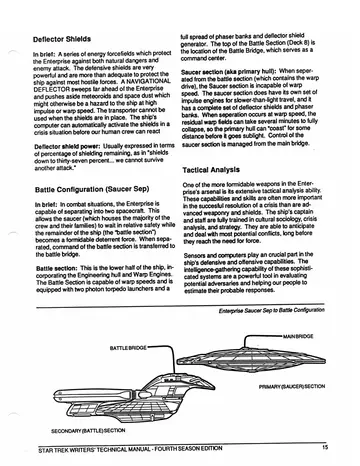
Enterprise Saucer Sep to Battle Configuration — diagram showing the Main Bridge and Battle Bridge and the separation into the Primary (Saucer) Section and the Secondary (Battle) Section.
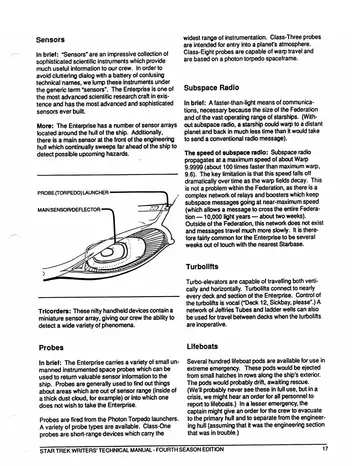
Main Sensor/Deflector and Probe/Torpedo Launcher — diagram of the engineering hull identifying the main sensor/deflector dish and the probe/torpedo launcher.
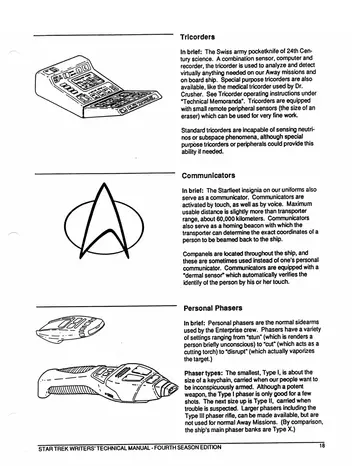
Tricorder — line drawing of the standard handheld tricorder.
Communicator — the Starfleet insignia combadge.
Personal Phasers — line drawings of the Type I and Type II hand phasers.
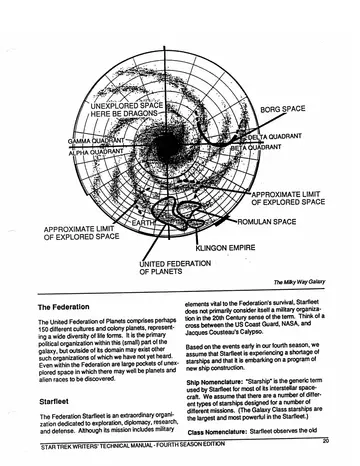
The Milky Way Galaxy — map of the galaxy showing the four quadrants (Alpha, Beta, Delta, Gamma), Earth and the United Federation of Planets, the Klingon Empire, Romulan Space, Borg Space, the approximate limits of explored space, and unexplored space labeled “Here Be Dragons”.
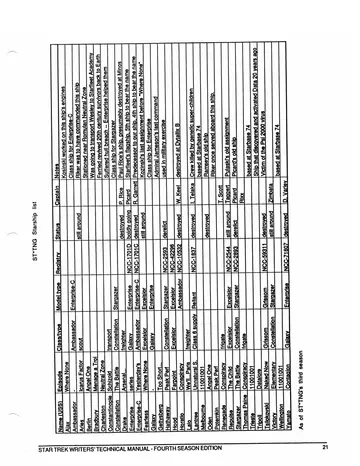
ST*TNG Starship list — table of established Federation starships giving each vessel's name, class-type, model used, registry, status, and notes.
The emblem of the Klingon Empire.
The standard of the Romulan Star Empire.
The symbol of the Borg.
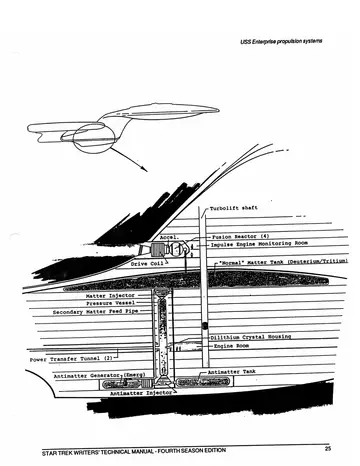
USS Enterprise propulsion systems — full-page cutaway of the secondary hull showing the impulse fusion reactor and drive coil, accelerator, normal matter (deuterium/tritium) tank, matter injector, pressure vessel, secondary matter feed pipe, dilithium crystal housing, engine room, power transfer tunnels, antimatter tank, antimatter generator (emergency), and antimatter injector.
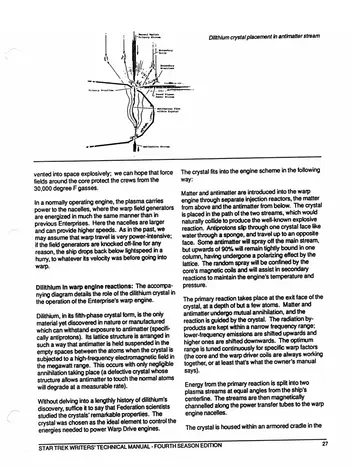
Dilithium crystal placement in antimatter stream — diagram of the crystal positioned where the matter and antimatter streams meet, with the primary reaction channelled to the warp engines.
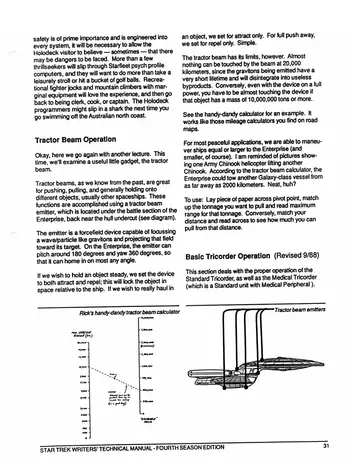
Rick's handy-dandy tractor beam calculator — nomograph-style chart relating object tonnage to maximum tractor-beam pulling distance.
Tractor beam emitters — diagram of the emitter location under the battle section of the Enterprise near the hull undercut.
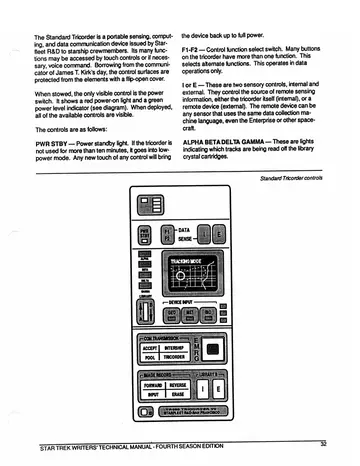
Standard Tricorder controls — labeled diagram of the open tricorder showing the data mode, sensor input, tracking menu, display screen, communications, image record, and library controls.
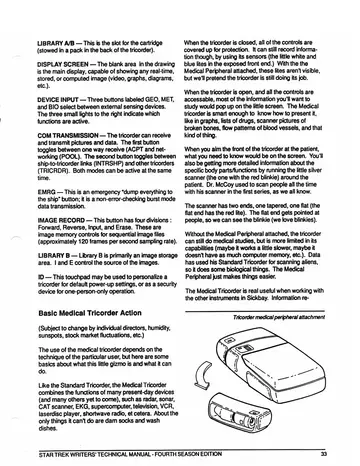
Tricorder medical peripheral attachment — drawing of the Medical Tricorder with its peripheral and hand-held silver scanner.
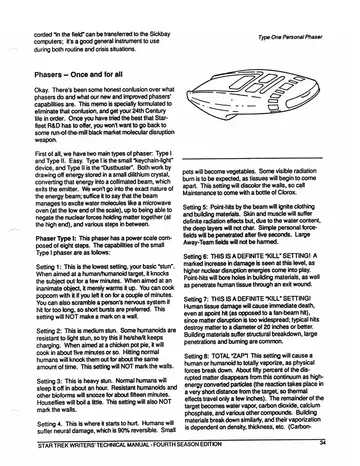
Type One Personal Phaser — drawing of the small “keychain-light” Type I hand phaser.
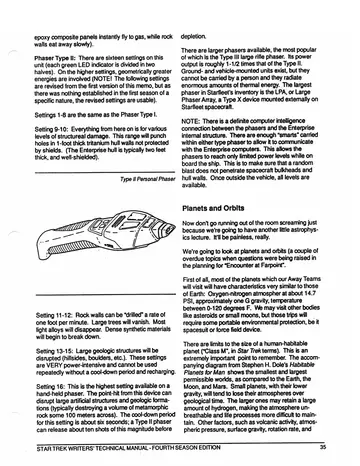
Type II Personal Phaser — drawing of the larger “Dustbuster” Type II hand phaser.
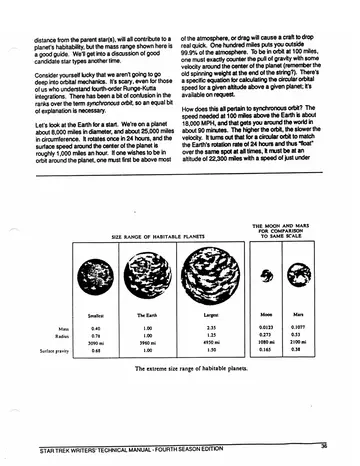
Size range of habitable planets — comparison diagram (after Stephen H. Dole) showing the smallest and largest habitable planets to scale beside the Earth, the Moon, and Mars, with a table of mass, radius, and surface gravity values.
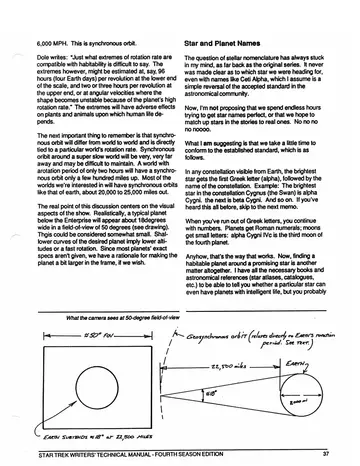
What the camera sees at 50-degree field-of-view — drawing showing a planet subtending roughly 18 degrees in a 50-degree field of view, with geosynchronous orbit at about 22,300 miles on Earth indicated.
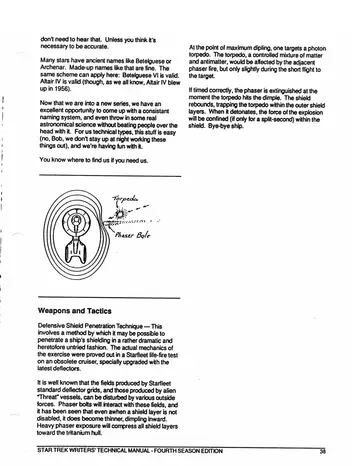
Defensive shield penetration — diagram of a photon torpedo and phaser bolt converging on a target's dimpled deflector shield.
Opening page of A Celestial Bestiary (text-only page).
Second page of the Celestial Bestiary entries (text-only page).
Third page of the Celestial Bestiary entries (text-only page).
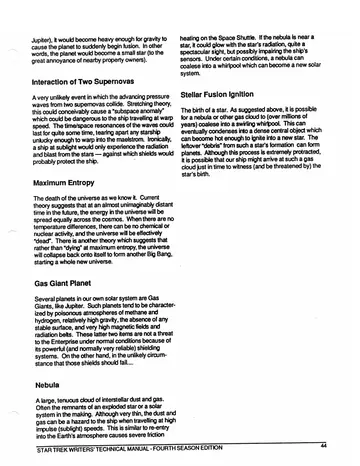
Final page of the Celestial Bestiary entries (text-only page).
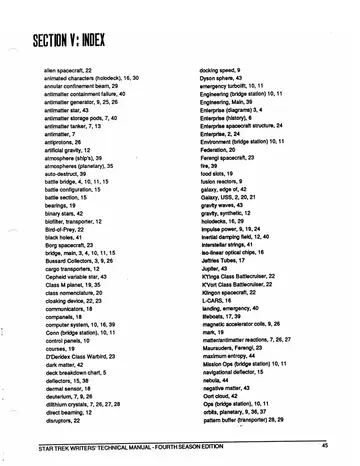
Index, alphabetical entries from alien spacecraft through Ops, with page references.
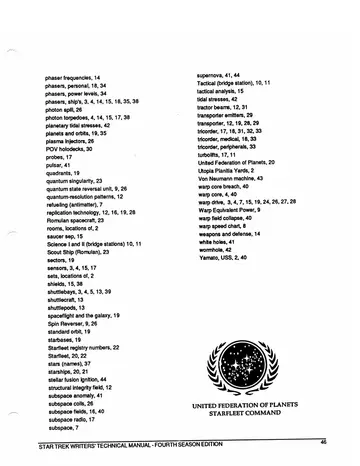
Emblem of the United Federation of Planets / Starfleet Command (laurel-encircled star field).