3.1 USS Enterprise Propulsion Systems
This memo completes the explanation of impulse drive, then details the matter/antimatter warp engine, the Bussard ram scoops, the matter-antimatter reaction ratios, and the crucial role of dilithium crystals in focusing and controlling the warp reaction.
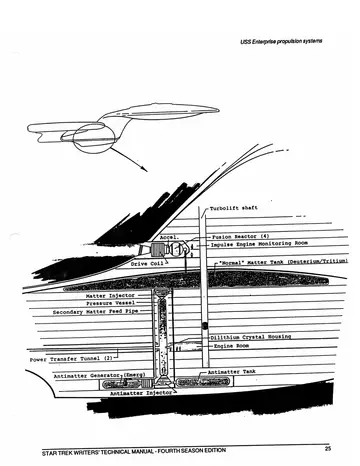
devices: A magnetic accelerator and a set of compact space-time (subspace) driver coils (the accelerator is modelled on a real device, the coils are magic at this point).
The superhot plasma is sped up within the accelerator, and the power is taken from there to run the driver coils. These coils perform the continuum “distortion” necessary to bring the ship up to .999 of the speed of light. They are, essentially, low-power versions of the coils used in the warp engines.
Since the combined mass of the two Enterprise components is close to 5,000,000 metric tons, pure exhaust thrust would not do the entire job, even if the plasma were shot out at nearly lightspeed (trust me; I won't bore you with Newton and Einstein to get the proof, but reaction physics below lightspeed works the same on the Space Shuttle as it does on the Enterprise).
The fuel supply for the fusion reactors is a set of large conformal tanks of liquid deuterium and tritium (-425F), both isotopes of hydrogen.
Warp Power: The warp engines operate on another principle altogether. The power needed to crack lightspeed is much greater, requiring 100+ times more energetic reactions. This is accomplished through the use of antimatter, specifically antiprotons. Matter and antimatter differ in atomic charge and spin direction, and will experience violent annihilation when brought together. The energy released by this process is used to power the warp field generators located in the outboard nacelles.
When a starship like the Enterprise is prepared for a long-duration mission, the matter and antimatter storage tanks are purged and refilled (the antimatter is stored in the form of antihydrogen liquid). Magnetic injectors, which operate like precision spray nozzles, are located at either end of the warp engine core. These injectors are primed, and the reaction begins when minute amounts of matter and antimatter plasma collide in the center of the core (also known as the engine pressure vessel). At this point the ratio of M:A is about 25:1, and the engine is at “idle”.
Normally the pressure in the engine is slowly brought up to about 10,000 PSI, roughly 715 times atmospheric pressure. More matter and antimatter react until their by-products fill the vessel. The ratio is adjusted until it reaches 10:1. A ratio of 1:1 is reached during Warp Factor 8; higher Warp Factors require greater amounts of reactants, but no further change in ratio.
Antiprotons will annihilate with anything, so residual gasses will eventually be used up. Engine control computers automatically keep the mixture balanced and introduce matter and antimatter through the injectors as needed to sustain the reaction.
There is a small onboard antimatter generator in the lower engineering hull. In crisis situations, this device produces small amounts of antimatter from normal matter, using a “quantum state reversal device”, a fancy way of saying that we have a magic box which flips the charge and spin of the normal matter. This process, while an effective way to get you out of a jam, is rather matter-intensive; that is, you get one atom of antimatter for every ten atoms of normal matter put in. The energy-cost is also extremely high, and this is not a “cost effective” way to create fuel.
This Enterprise, like its predecessors, is equipped with Bussard ram collector scoops. These gizmos allow it to collect some of the very tenuous interstellar hydrogen atoms it encounters in flight. This presupposes that during warp travel the ship doesn't disappear from this universe into another dimension; if it hit an asteroid at Warp 9.6 it would definitely get creamed.
Dilithium Crystals
The reaction within the core, a continuous thermonuclear process, must be regulated by those rare and mysterious objects we've all come to know, dilithium crystals.
Dilithium, which is probably short for a longer compound name like dilithium diallosilicate heptoferranide, works to focus and “fine tune” the radiated energy of the reaction and channel it into the two power transfer tunnels leading to the warp nacelles. The exposed crystal assembly extends into the core. It can be imagined that radiation of different frequencies enters the lattice structure of the crystal, is bounced and bent about, and exits the crystal in a narrower (perhaps “smoother”) range of frequencies down the power transfer tunnels. Order-out-of-chaos. (See following separate notes on dilithium).
The bright light we see coming from the engine is merely photon spill, mostly harmless, but the patterns are a valuable indicator to the engineer on duty as to how smoothly the engine is running, much like an auto mechanic listening to a car engine.
If your dilithium crystals shatter or melt, a cold shutdown may occur, depending on the mixture and power level in the core. We might also imagine a fast (but short-lived) runaway reaction which would heat the core to unacceptable levels, even if the injectors are shut off. If the pressure vessel of the core is breached, the contained plasma would have to be vented into space explosively; we can hope that force fields around the core protect the crews from the 30,000 degree F gasses.
In a normally operating engine, the plasma carries power to the nacelles, where the warp field generators are energized in much the same manner than in previous Enterprises. Here the nacelles are larger and can provide higher speeds. As in the past, we may assume that warp travel is very power-intensive; if the field generators are knocked off-line for any reason, the ship drops back below lightspeed in a hurry, to whatever its velocity was before going into warp.
Dilithium in Warp Engine Reactions
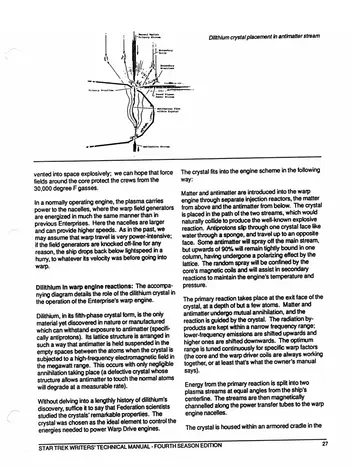
The accompanying diagram details the role of the dilithium crystal in the operation of the Enterprise's warp engine.
Dilithium, in its fifth-phase crystal form, is the only material yet discovered in nature or manufactured by which can withstand exposure to antimatter (specifically antiprotons). Its lattice structure is arranged in such a way that antimatter is held suspended in the empty spaces between the atoms when the crystal is subjected to a high-frequency electromagnetic field in the megawatt range. This occurs with only negligible annihilation taking place (a defective crystal whose structure allows antimatter to touch the normal atoms will degrade at a measurable rate).
Without delving into a lengthly history of dilithium's discovery, suffice it to say that Federation scientists studied the crystals' remarkable properties. The crystal was chosen as the ideal element to control the energies needed to power Warp Drive engines.
The crystal fits into the engine scheme in the following way:
Matter and antimatter are introduced into the warp engine through separate injection reactors, the matter from above and the antimatter from below. The crystal is placed in the path of the two streams, which would naturally collide to produce the well-known explosive reaction. Antiprotons slip through one crystal face like water through a sponge, and travel up to an opposite face. Some antimatter will spray off the main stream, but upwards of 90% will remain tightly bound in one column, having undergone a polarizing effect by the lattice. The random spray will be confined by the core's magnetic coils and will assist in secondary reactions to maintain the engine's temperature and pressure.
The primary reaction takes place at the exit face of the crystal, at a depth of but a few atoms. Matter and antimatter undergo mutual annihilation, and the reaction is guided by the crystal. The radiation products are kept within a narrow frequency range; lower-frequency emissions are shifted upwards and higher ones are shifted downwards. The optimum range is tuned continuously for specific warp factors (the core and the warp driver coils are always working together, or at least that's what the owner's manual says).
Energy from the primary reaction is split into two plasma streams at equal angles from the ship's centerline. The streams are then magnetically channelled along the power transfer tubes to the warp engine nacelles.
The crystal is housed within an armored cradle in the core and held by a jointed gripper mechanism. This gripper is able to move through three axes, since the tuned plasma streams will not form unless the crystal is precisely aligned by computer control. The gripper also acts as a power supply for the high-energy field which enables the crystals to withstand the antimatter stream. Once alignment is made and the gripper is energized, the plasma ripples down the power transfer tubes and up to the warp nacelles. The “throttle” for each engine is a set of valved plasma injectors just below the warp driver coils.
As a crystal is used, it “evaporates” atoms off each face, usually at a constant rate. If the crystal has a defect undetected during testing, the boil-off rate may become asymmetrical and the plasma streams will degrade.
Another change which crystals can undergo is “de-crystalization”, or the conversion of the dilithium from a crystalline solid to an amorphous solid, where the atoms in the compounds become less tightly-locked in a specific lattice. Crystals of a century before could be returned to their rigid structure with the re-introduction of gamma-ray photons, but their application was tied to engines of only 75% thermodynamic efficiency. Today's dilithium crystals differ in the addition of one atom (industrially, by nuclear supercollider) and are tied to warp driver coils boasting 89% efficiency, and their reconstitution is possible only through the use of dedicated fusion furnaces. In this process, a crystal is totally vaporized and recrystalized with a gas-to-solid phase technique.
This concludes our lecture, and isn't it even more than you ever wanted to know about the engine?