2.6 Impulse Power
A description of additional warp-drive refueling methods (the Bussard collector and quantum state reversal unit) and other uses of warp power, followed by an explanation of the impulse propulsion system covering its power, fuel, speed, and the terminology used for sublight travel.
Other means of refueling: The front of the warp engine nacelles incorporates a set of powerful electromagnetic coils called a BUSSARD COLLECTOR. When the ship is travelling at high speed, these coils generate an electromagnetic field which collects stray atoms of interstellar hydrogen for use as fuel. The warp drive system also incorporates a device called a QUANTUM STATE REVERSAL UNIT, also called a “spin reverser” or an antimatter generator. This device uses transporter-based technology to actually dematerialize a quantity of hydrogen and rematerialize it with reversed charge and spin, thereby converting it to antimatter! The limitation here is that the spin reverser is extremely energy inefficient — it takes a whole lot of energy from the fusion generators to create a relatively small amount of antimatter.
Other uses of warp power: When necessary, we can pull power directly from the warp core for applications which require massive amounts of energy. In the past, such situations have included applying warp power directly to the main deflector and using the warp fields for non-propulsive tasks. Such power usage is generally measured in WARP EQUIVALENT POWER comparisons, as in “we're feeding the main deflector with Warp equivalent power nine.”
Impulse Power
In brief: The Enterprise uses its IMPULSE POWER propulsion system for slower-than-light travel. The distances between the stars are so vast that impulse power is generally used only while in orbit or within a solar system.
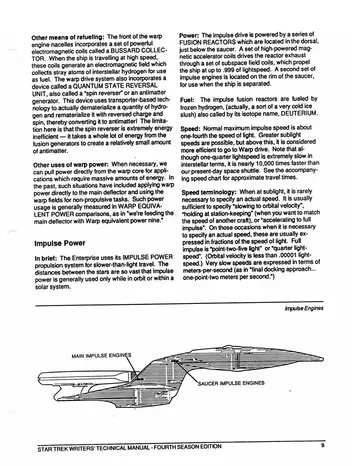
Power: The impulse drive is powered by a series of FUSION REACTORS which are located in the dorsal, just below the saucer. A set of high-powered magnetic accelerator coils drives the reactor exhaust through a set of subspace field coils, which propel the ship at up to .999 of lightspeed. A second set of impulse engines is located on the rim of the saucer, for use when the ship is separated.
Fuel: The impulse fusion reactors are fueled by frozen hydrogen, (actually, a sort of a very cold ice slush) also called by its isotope name, DEUTERIUM.
Speed: Normal maximum impulse speed is about one-fourth the speed of light. Greater sublight speeds are possible, but above this, it is considered more efficient to go to Warp drive. Note that although one-quarter lightspeed is extremely slow in interstellar terms, it is nearly 10,000 times faster than our present-day space shuttle. See the accompanying speed chart for approximate travel times.
Speed terminology: When at sublight, it is rarely necessary to specify an actual speed. It is usually sufficient to specify “slowing to orbital velocity”, “holding at station-keeping” (when you want to match the speed of another craft), or “accelerating to full impulse”. On those occasions when it is necessary to specify an actual speed, these are usually expressed in fractions of the speed of light. Full impulse is “point-two-five light” or “quarter lightspeed”. (Orbital velocity is less than .00001 lightspeed.) Very slow speeds are expressed in terms of meters-per-second (as in “final docking approach... one-point-two meters per second.”)