3.7 Planets and Orbits
This memo reviews the characteristics and size limits of habitable Class M planets and explains orbital mechanics, including why synchronous orbit varies from world to world and how a planet should appear from the Enterprise.
Planets and Orbits
Now don't go running out of the room screaming just because we're going to have another little astrophysics lecture. It'll be painless, really.
We're going to look at planets and orbits (a couple of overdue topics when questions were being raised in the planning for “Encounter at Farpoint”.
First of all, most of the planets which our Away Teams will visit will have characteristics very similar to those of Earth: Oxygen-nitrogen atmosphere at about 14.7 PSI, approximately one G gravity, temperature between 0-120 degrees F. We may visit other bodies like asteroids or small moons, but those trips will require some portable environmental protection, be it spacesuit or force field device.
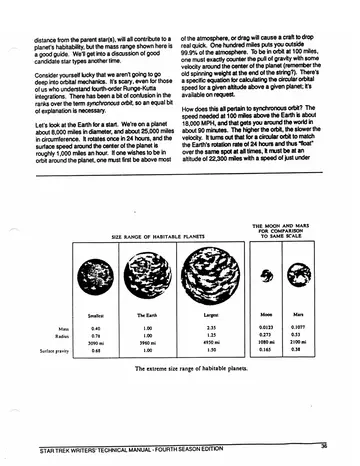
There are limits to the size of a human-habitable planet (“Class M”, in Star Trek terms). This is an extremely important point to remember. The accompanying diagram from Stephen H. Dole's Habitable Planets for Man shows the smallest and largest permissible worlds, as compared to the Earth, the Moon, and Mars. Small planets, with their lower gravity, will tend to lose their atmospheres over geological time. The larger ones may retain a large amount of hydrogen, making the atmosphere unbreathable and life processes more difficult to maintain. Other factors, such as volcanic activity, atmospheric pressure, surface gravity, rotation rate, and distance from the parent star(s), will all contribute to a planet's habitability, but the mass range shown here is a good guide. We'll get into a discussion of good candidate star types another time.
Consider yourself lucky that we aren't going to go deep into orbital mechanics. It's scary, even for those of us who understand fourth-order Runge-Kutta integrations. There has been a bit of confusion in the ranks over the term synchronous orbit, so an equal bit of explanation is necessary.
Let's look at the Earth for a start. We're on a planet about 8,000 miles in diameter, and about 25,000 miles in circumference. It rotates once in 24 hours, and the surface speed around the center of the planet is roughly 1,000 miles an hour. If one wishes to be in orbit around the planet, one must first be above most of the atmosphere, or drag will cause a craft to drop real quick. One hundred miles puts you outside 99.9% of the atmosphere. To be in orbit at 100 miles, one must exactly counter the pull of gravity with some velocity around the center of the planet (remember the old spinning weight at the end of the string?). There's a specific equation for calculating the circular orbital speed for a given altitude above a given planet; it's available on request.
How does this all pertain to synchronous orbit? The speed needed at 100 miles above the Earth is about 18,000 MPH, and that gets you around the world in about 90 minutes. The higher the orbit, the slower the velocity. It turns out that for a circular orbit to match the Earth's rotation rate of 24 hours and thus “float” over the same spot at all times, it must be at an altitude of 22,300 miles with a speed of just under 6,000 MPH. This is synchronous orbit.
Dole writes: “Just what extremes of rotation rate are compatible with habitability is difficult to say. The extremes however, might be estimated at, say, 96 hours (four Earth days) per revolution at the lower end of the scale, and two or three hours per revolution at the upper end, or at angular velocities where the shape becomes unstable because of the planet's high rotation rate.” The extremes will have adverse effects on plants and animals upon which human life depends.
The next important thing to remember is that synchronous orbit will differ from world to world and is directly tied to a particular world's rotation rate. Synchronous orbit around a super slow world will be very, very far away and may be difficult to maintain. A world with a rotation period of only two hours will have a synchronous orbit only a few hundred miles up. Most of the worlds we're interested in will have synchronous orbits like that of earth, about 20,000 to 25,000 miles out.
The real point of this discussion centers on the visual aspects of the show. Realistically, a typical planet below the Enterprise will appear about 18 degrees wide in a field-of-view of 50 degrees (see drawing). This could be considered somewhat small. Shallower curves of the desired planet imply lower altitudes or a fast rotation. Since most planets' exact specs aren't given, we have a rationale for making the planet a bit larger in the frame, if we wish.