2.16 The Milky Way Galaxy, The Federation & Starfleet
An introduction to the setting of the series: the layout of the Milky Way Galaxy, the makeup of the United Federation of Planets, and the role and ship-naming conventions of Starfleet.
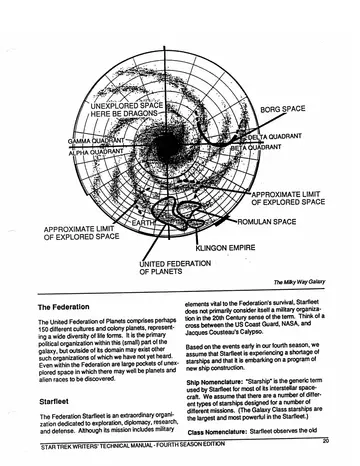
The Federation
The United Federation of Planets comprises perhaps 150 different cultures and colony planets, representing a wide diversity of life forms. It is the primary political organization within this (small) part of the galaxy, but outside of its domain may exist other races, of which we have not yet heard. Even within the Federation are large pockets of unexplored space in which there may well be planets and alien races to be discovered.
Starfleet
The Federation Starfleet is an extraordinary organization dedicated to exploration, diplomacy, research, and defense. Although its mission includes military elements vital to the Federation's survival, Starfleet does not primarily consider itself a military organization in the 20th Century sense of the term. Think of a cross between the US Coast Guard, NASA, and Jacques Cousteau's Calypso.
Based on the events early in our fourth season, we assume that Starfleet is experiencing a shortage of starships and that it is embarking on a program of new ship construction.
Ship Nomenclature: “Starship” is the generic term used by Starfleet for most of its interstellar spacecraft. We assume that there are a number of different types of starships designed for a number of different missions. (The Galaxy Class starships are the largest and most powerful in the Starfleet.)
Class Nomenclature: Starfleet observes the old Naval tradition of naming each class of starships after the first ship built of its type. For example, the Enterprise is a Galaxy Class starship, presumably named after the USS Galaxy, which would have been the first starship of that type built. The USS Stargazer, (Picard's former ship) was a Constellation Class starship, while the original Enterprise (commanded by Captain Kirk), was a Constitution Class vessel.
Starfleet Registry Numbers: Each Starship is identified by a Starfleet Registry Number, such as the Enterprise's NCC-1701-D. Most current (ST*TNG) Starfleet vessels have five-digit registry numbers, such as the USS Yamato, which was NCC-71807, or the USS Hood, NCC-42296. Most Starfleet operational vessels have the characteristic “NCC” prefix, although some experimental ships have an “NX” designation. Additionally, we assume that various non-Starfleet vessels under Federation jurisdiction will have other prefixes (such as NAR-18834). (Note that the Enterprise is a special case in that Starfleet chooses to honor the original Enterprise by continuing the “1701” designation in its registry number. The Enterprise is the only Starfleet vessel with a letter suffix in its registry number.)