1.6 Sector Grid System
Explains how sector grids subdivide into sector quads, sector blocks, and individual sectors, and how the resulting five-digit designations are abbreviated in common usage.
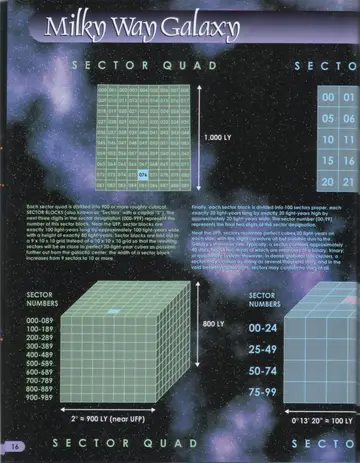
Sector grids are divided into 100 sector quads of equal volume, which are numbered 00 through 99; these represent the third and fourth digits in the sector designation (prior to the mid-24th Century, sector quads were commonly although mistakenly referred to as “quadrants”). Note that closer to the galactic center, sector quads will resemble wedges rather than cubes, and the further from the center of the Galaxy, the larger the volume of space contained in each sector quad.
Each sector quad is divided into 100 or more roughly cubical sector blocks (also known as “Sectors” with a capital “S”). The next three digits in the sector designation (000–999) represent the number of this sector block. Near the UFP, sector blocks are exactly 100 light-years long by approximately 100 light-years wide, with a height of exactly 80 light-years. Sector blocks are laid out in a 9 x 10 x 10 grid instead of a 10 x 10 x 10 grid so that the resulting sectors will be as close to perfect 20-light-year cubes as possible; further out from the galactic center, the width of a sector block increases from 9 sectors to 10 or more.
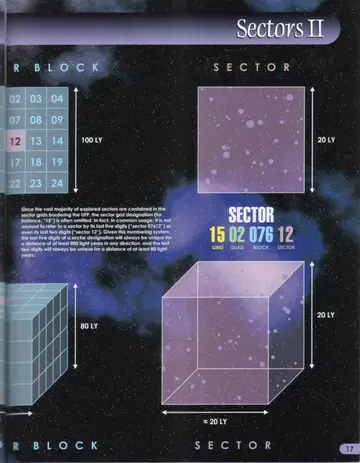
Finally, each sector block is divided into 100 sectors proper, each exactly 20 light-years long by exactly 20 light-years high by approximately 20 light-years wide. The sector number (00–99) represents the final two digits of the sector designation.
Near the UFP, sectors resemble perfect cubes, 20 light-years on each side, with the slight curvature still invisible due to the Galaxy's immense size. Typically, a sector contains approximately 40 stars, about two-thirds of which are members of a binary, trinary, or quaternary system. However, in dense globular star clusters, a sector may contain as many as several thousand stars; and in the void between globular clusters, sectors may contain only stray gas.
Since the vast majority of explored sectors are contained in the sector grids bordering the UFP, the sector grid designation (for instance, “15”) is often omitted. In fact, in common usage, it is not unusual to refer to a sector by its last five digits (“sector 07612”) or even its last two digits (“sector 12”). Given this numbering system, the last five digits of a sector designation will always be unique for a distance of at least 800 light years in any direction, and the last two digits will always be unique for a distance of at least 80 light years.