Star Charts · Chapter 3 · Planets
3.2 Planetary Classes G–I (Geocrystalline, Desert, Gas Supergiant)
Reference data for planetary classes G, H and I, listing age, diameter, location, surface, atmosphere, evolution, life-forms and examples for each.
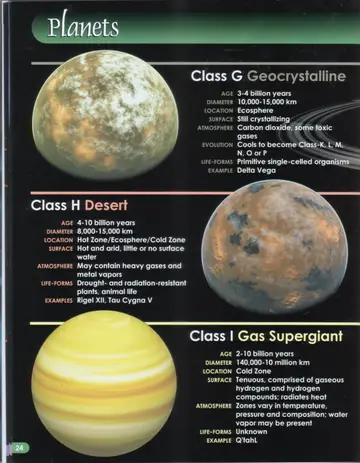
Class G Geocrystalline planet, a pale tan crystallizing world.
Class H Desert planet, a hot arid world with mottled brown and grey terrain.
Class I Gas Supergiant, a banded yellow gas world.
Class G — Geocrystalline
- Age: 3-4 billion years
- Diameter: 10,000-15,000 km
- Location: Ecosphere
- Surface: Still crystallizing
- Atmosphere: Carbon dioxide, some toxic gases
- Evolution: Cools to become Class-K, L, M, N, O or P
- Life-forms: Primitive single-celled organisms
- Example: Delta Vega
Class H — Desert
- Age: 4-10 billion years
- Diameter: 8,000-15,000 km
- Location: Hot Zone/Ecosphere/Cold Zone
- Surface: Hot and arid, little or no surface water
- Atmosphere: May contain heavy gases and metal vapors
- Life-forms: Drought- and radiation-resistant plants, animal life
- Examples: Rigel XII, Tau Cygna V
Class I — Gas Supergiant
- Age: 2-10 billion years
- Diameter: 140,000-10 million km
- Location: Cold Zone
- Surface: Tenuous, comprised of gaseous hydrogen and hydrogen compounds; radiates heat
- Atmosphere: Zones vary in temperature, pressure and composition; water vapor may be present
- Life-forms: Unknown
- Example: Q'tahL