1.0 Physical
An overview of the Milky Way's physical statistics, spiral-arm structure, satellite galaxies, the Local Group, and the two stellar populations.


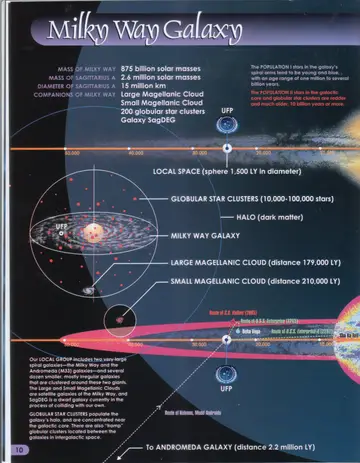
Our Local Group includes two very large spiral galaxies—the Milky Way and the Andromeda (M33) galaxies—and several dozen smaller, mostly irregular galaxies that are clustered around these two giants. The Large and Small Magellanic Clouds are satellite galaxies of the Milky Way, and SagDEG is a dwarf galaxy currently in the process of colliding with our own.
Globular star clusters populate the galaxy's halo, and are concentrated near the galactic core. There are also “tramp” globular clusters located between the galaxies in intergalactic space.
The Population I stars in the galaxy's spiral arms tend to be young and blue, with an age range of one million to several billion years. The Population II stars in the galactic core and globular star clusters are redder and much older, 10 billion years or more.
Galactic Statistics
- Type: Sbc
- Age: 13 billion years
- Diameter: 100,000 light-years
- Thickness at center: 15,000 light-years
- Stellar population: 500,000 million stars
- Orbital period of UFP: 220 million years
- Mass of Milky Way: 875 billion solar masses
- Mass of Sagittarius A: 2.6 million solar masses
- Diameter of Sagittarius A: 15 million km
- Companions of Milky Way: Large Magellanic Cloud, Small Magellanic Cloud, 200 globular star clusters, Galaxy SagDEG