Star Charts · Chapter 2 · Stars
2.0 Spectral Classes (O, B, A, F, G)
Reference data for the hotter spectral classes O, B, A, F and G, listing temperature, composition and an example star for each, followed by a note on subclasses and luminosity categories.
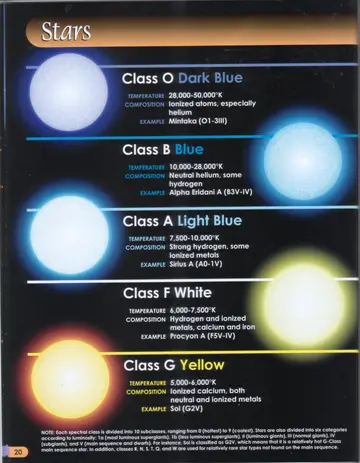
Illustrated comparison of stellar spectral classes O, B, A, F and G, each shown as a glowing star coloured by class with temperature, composition and an example star.
Class O — Dark Blue
- Temperature: 28,000-50,000°K
- Composition: Ionized atoms, especially helium
- Example: Mintaka (O1-3III)
Class B — Blue
- Temperature: 10,000-28,000°K
- Composition: Neutral helium, some hydrogen
- Example: Alpha Eridani A (B3V-IV)
Class A — Light Blue
- Temperature: 7,500-10,000°K
- Composition: Strong hydrogen, some ionized metals
- Example: Sirius A (A0-1V)
Class F — White
- Temperature: 6,000-7,500°K
- Composition: Hydrogen and ionized metals, calcium and iron
- Example: Procyon A (F5V-IV)
Class G — Yellow
- Temperature: 5,000-6,000°K
- Composition: Ionized calcium, both neutral and ionized metals
- Example: Sol (G2V)
Each spectral class is divided into 10 subclasses, ranging from 0 (hottest) to 9 (coolest). Stars are also divided into six categories according to luminosity: 1a (most luminous supergiants), 1b (less luminous supergiants), II (luminous giants), III (normal giants), IV (subgiants), and V (main sequence and dwarfs). For instance, Sol is classified as G2V, which means that it is a relatively hot G-Class main sequence star. In addition, classes R, N, S, T, Q, and W are used for relatively rare star types not found on the main sequence.