Star Charts · Chapter 3 · Planets
3.1 Planetary Classes D–F (Asteroid/Moon, Geoplastic, Geometallic)
Reference data for planetary classes D, E and F, listing age, diameter, location, surface, atmosphere, evolution, life-forms and examples for each.
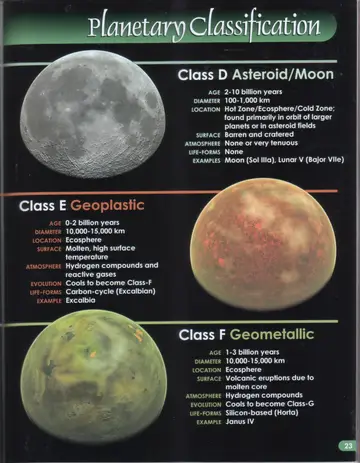
Class D Asteroid/Moon, a barren cratered grey body resembling Earth's Moon.
Class E Geoplastic planet, a molten tan-and-red world.
Class F Geometallic planet, a green volcanic world.
Class D — Asteroid/Moon
- Age: 2-10 billion years
- Diameter: 100-1,000 km
- Location: Hot Zone/Ecosphere/Cold Zone; found primarily in orbit of larger planets or in asteroid fields
- Surface: Barren and cratered
- Atmosphere: None or very tenuous
- Life-forms: None
- Examples: Moon (Sol IIIa), Lunar V (Bajor VIIe)
Class E — Geoplastic
- Age: 0-2 billion years
- Diameter: 10,000-15,000 km
- Location: Ecosphere
- Surface: Molten, high surface temperature
- Atmosphere: Hydrogen compounds and reactive gases
- Evolution: Cools to become Class-F
- Life-forms: Carbon-cycle (Excalbian)
- Example: Excalbia
Class F — Geometallic
- Age: 1-3 billion years
- Diameter: 10,000-15,000 km
- Location: Ecosphere
- Surface: Volcanic eruptions due to molten core
- Atmosphere: Hydrogen compounds
- Evolution: Cools to become Class-G
- Life-forms: Silicon-based (Horta)
- Example: Janus IV