Star Charts · Chapter 3 · Planets
3.4 Class M Terrestrial (Minshara Class)
Reference data and description for the Class M (Minshara Class) terrestrial planet, including its variability, typical internal structure, and the classification fields of age, diameter, location, surface, atmosphere, life-forms and examples.
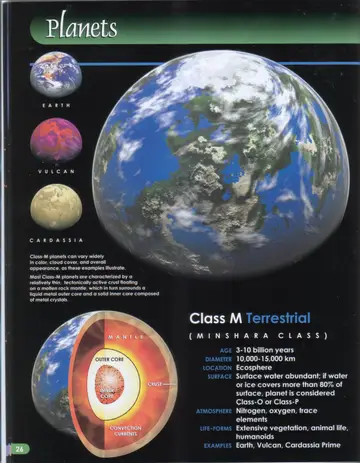
A large blue-and-white Class M planet resembling Earth, shown with clouds, oceans and continents.
Comparative Class M examples labelled Earth, Vulcan and Cardassia, illustrating the wide variation in colour and appearance.
Cutaway diagram of a Class M planet's interior, showing the crust, mantle, outer core, inner core and convection currents.
Class-M planets can vary widely in color, cloud cover, and overall appearance, as these examples illustrate.
Most Class-M planets are characterized by a relatively thin, tectonically active crust floating on a molten rock mantle, which in turn surrounds a liquid metal outer core and a solid inner core composed of metal crystals.
Class M — Terrestrial (Minshara Class)
- Age: 3-10 billion years
- Diameter: 10,000-15,000 km
- Location: Ecosphere
- Surface: Surface water abundant; if water or ice covers more than 80% of surface, planet is considered Class-O or Class-P
- Atmosphere: Nitrogen, oxygen, trace elements
- Life-forms: Extensive vegetation, animal life, humanoids
- Examples: Earth, Vulcan, Cardassia Prime