8.1 The Enterprise
An overview of the Galaxy Class, covering its Utopia Planitia construction and Constitution Class lineage, the separable Saucer Module and Battle Section, impulse and transporter systems, and the layout of the main bridge, ready room, and conference lounge.
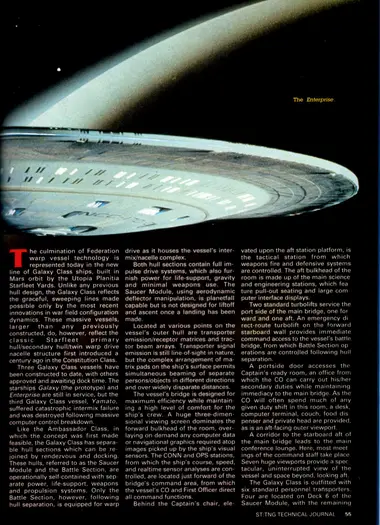
The culmination of Federation warp vessel technology is represented today in the new line of Galaxy Class ships, built in Mars orbit by the Utopia Planitia Starfleet Yards. Unlike any previous hull design, the Galaxy Class reflects the graceful, sweeping lines made possible only by the most recent innovations in war field configuration dynamics. These massive vessels, larger than any previously constructed, do, however, reflect the classic Starfleet primary hull/secondary hull/twin warp drive nacelle structure first introduced a century ago in the Constitution Class.
Three Galaxy Class vessels have been constructed to date, with others approved and awaiting dock time. The starships Galaxy (the prototype) and Enterprise are still in service, but the third Galaxy Class vessel, Yamato, suffered catastrophic intermix failure and was destroyed following massive computer control breakdown.
Like the Ambassador Class, in which the concept was first made feasible, the Galaxy Class has separable hull sections which can be rejoined by rendezvous and docking. These hulls, referred to as the Saucer Module and the Battle Section, are operationally self-contained with separate power, life-support, weapons and propulsion systems. Only the Battle Section, however, following hull separation, is equipped for warp drive as it houses the vessel's intermix/nacelle complex.
Both hull sections contain full impulse drive systems, which also furnish power for life-support, gravity and minimal weapons use. The Saucer Module, using aerodynamic deflector manipulation, is planetfall capable but is not designed for liftoff and ascent once a landing has been made.
Located at various points on the vessel's outer hull are transporter emission/receptor matrices and tractor beam arrays. Transporter signal emission is still line-of-sight in nature, but the complex arrangement of matrix pads on the ship's surface permits simultaneous beaming of separate persons/objects in different directions and over widely disparate distances.
The vessel's bridge is designed for maximum efficiency while maintaining a high level of comfort for the ship's crew. A huge three-dimensional viewing screen dominates the forward bulkhead of the room, overlaying on demand any computer data or navigational graphics required atop images picked up by the ship's visual sensors. The CONN and OPS stations, from which the ship's course, speed, and realtime sensor analyses are controlled, are located just forward of the bridge's command area, from which the vessel's CO and First Officer direct all command functions.
Behind the Captain's chair, elevated upon the aft station platform, is the tactical station from which weapons fire and defensive systems are controlled. The aft bulkhead of the room is made up of the main science and engineering stations, which feature pull-out seating and large computer interface displays.
Two standard turbolifts service the port side of the main bridge, one forward and one aft. An emergency direct-route turbolift on the forward starboard wall provides immediate command access to the vessel's battle bridge, from which Battle Section operations are controlled following hull separation.
A portside door accesses the Captain's ready room, an office from which the CO can carry out his/her secondary duties while maintaining immediacy to the main bridge. As the CO will often spend much of any given duty shift in this room, a desk, computer terminal, couch, food dispenser and private head are provided, as is an aft-facing outer viewport.
A corridor to the starboard aft of the main bridge leads to the main conference lounge. Here, most meetings of the command staff take place. Seven huge viewports provide a spectacular, uninterrupted view of the vessel and space beyond, looking aft.
The Galaxy Class is outfitted with six standard personnel transporters. Four are located on Deck 6 of the Saucer Module, with the remaining