10.5 The Klingons
Describes the Klingons as a former Federation enemy turned ally, detailing their warrior culture, hand-to-hand and disruptor weaponry, and imposing physiology marked by the ridged forehead crown.
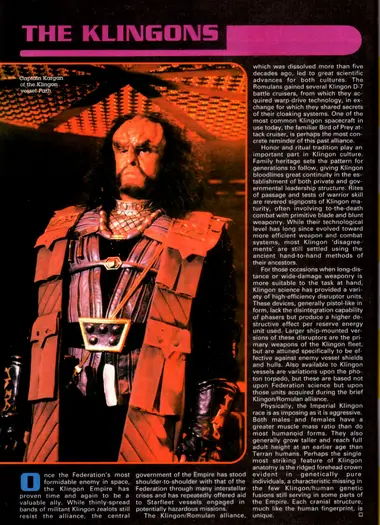
Once the Federation's most formidable enemy in space, the Klingon Empire has proven time and again to be a valuable ally. While thinly-spread bands of militant Klingon zealots still resist the alliance, the central government of the Empire has stood shoulder-to-shoulder with that of the Federation through many interstellar crises and has repeatedly offered aid to Starfleet vessels engaged in potentially hazardous missions.
The Klingon/Romulan alliance, which was dissolved more than five decades ago, led to great scientific advances for both cultures. The Romulans gained several Klingon D-7 battle cruisers, from which they acquired warp-drive technology, in exchange for which they shared secrets of their cloaking systems. One of the most common Klingon spacecraft in use today, the familiar Bird of Prey attack cruiser, is perhaps the most concrete reminder of this past alliance.
Honor and ritual tradition play an important part in Klingon culture. Family heritage sets the pattern for generations to follow, giving Klingon bloodlines great continuity in the establishment of both private and governmental leadership structure. Rites of passage and tests of warrior skill are revered signposts of Klingon maturity, often involving to-the-death combat with primitive blade and blunt weaponry. While their technological level has long since evolved toward more efficient weapon and combat systems, most Klingon “disagreements” are still settled using the ancient hand-to-hand methods of their ancestors.
For those occasions when long-distance or wide-damage weaponry is more suitable to the task at hand, Klingon science has provided a variety of high-efficiency disruptor units. These devices, generally pistol-like in form, lack the disintegration capability of phasers but produce a higher destructive effect per reserve energy unit used. Larger ship-mounted versions of these disruptors are the primary weapons of the Klingon fleet, but are attuned specifically to be effective against enemy vessel shields and hulls. Also available to Klingon vessels are variations upon the photon torpedo, but these are based not upon Federation science but upon those units acquired during the brief Klingon/Romulan alliance.
Physically, the Imperial Klingon race is as imposing as it is aggressive. Both males and females have a greater muscle mass ratio than do most humanoid forms. They also generally grow taller and reach full adult height at an earlier age than Terran humans. Perhaps the single most striking feature of Klingon anatomy is the ridged forehead crown evident in genetically pure individuals, a characteristic missing in the few Klingon/human genetic fusions still serving in some parts of the Empire. Each cranial structure, much like the human fingerprint, is unique.