3.10 Page 71
B84 CARDASSIAN PHASE DISRUPTOR RIFLE THE STAR TREX ENCYCLOPEDIA: A REFERENCE GUIDE TO THE FUTURE Chief Miles O'Brien to review Cardassian operational
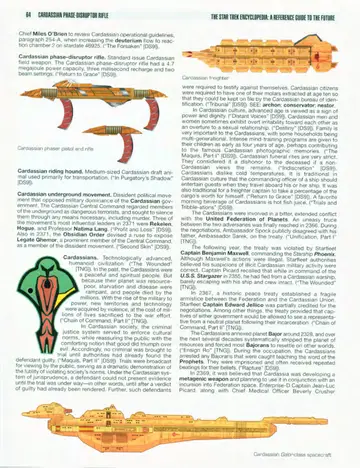
B84 CARDASSIAN PHASE DISRUPTOR RIFLE THE STAR TREX ENCYCLOPEDIA: A REFERENCE GUIDE TO THE FUTURE Chief Miles O'Brien to review Cardassian operational guidelines, "\ paragraph 254-A, when increasing the deuterium flow to reac- CT e.g 2) =~ tion chamber 2 on stardate 46925. (“The Forsaken" [DS9)]). Y= mr We mn — {Fd = i. ) = Cardassian phase-disruptor rifle. Standard issue Cardassian _ NEC) - » ™ field weapon. The Cardassian phase-disruptor rifle had a 4.7 28 fg pn ~3. 0 O—i megajoule power capacity, three millisecond recharge and two 2 — = CY ey ee = beam settings. (“Return to Grace" [DS9)). Cardassian freighter were required to testify against themselves. Cardassian citizens were required to have one of their molars extracted at age ten so that they could be kept on file by the Cardassian bureau of identification. (“Tribunal” [DS9]). SEE: archon; conservator; nestor. In Cardassian culture, advanced age is viewed as a sign of power and dignity. (“Distant Voices” [DS9]). Cardassian men and women sometimes exhibit overt irritability toward each other as an overture to a sexual relationship. (“Destiny [DS9]). Family is very important to the Cardassians, with some households being multi-generational. Intense mind-training programs are given to their children as early as four years of age, perhaps contributing Cardassian phaser pistol and rifle to the famous Cardassian photographic memories. (“The Maquis, Part I” [DS9]). Cardassian funeral rites are very strict. They considered it a dishonor to the deceased if a nonCardassian views the remains. (“Indiscretion” [DS9)). Cardassian riding hound. Medium-sized Cardassian draft ani- Cardassians dislike cold temperatures. It is traditional in mal used primarily for transportation. (“In Purgatory's Shadow” Cardassian culture that the commanding officer of a ship should (DS9)). entertain guests when they travel aboard his or her ship. It was also traditional for a freighter captain to take a percentage of the Cardassian underground movement. Dissident political move- cargo’s worth for himself. (“Return to Grace” [DS9]). A favorite ment that opposed military dominance of the Cardassian gov- morning beverage of Cardassians is hot fish juice. (“Trials and ermment. The Cardassian Central Command regarded members Tribble-ations” [DS9)). of the underground as dangerous terrorists, and sought to silence The Cardassians were involved in a bitter, extended conflict them through any means necessary, including murder. Three of with the United Federation of Planets. An uneasy truce the movement's most influential leaders in 2371 were Rekelen, between the two adversaries was finally reached in 2366. During Hogue, and Professor Natima Lang. (“Profit and Loss” [DS9)). the negotiations, Ambassador Spock publicly disagreed with his Also in 2371, the Obsidian Order devised a ruse to expose father, Ambassador Sarek, on the treaty. (“Unification, Part |” Legate Ghemor, a prominent member of the Central Command, [TNG]). as a member of the dissident movement. (“Second Skin" [DS9)). The following year, the treaty was violated by Starfleet Captain Benjamin Maxwell, commanding the Starship Phoenix. Cardassians. Technologically advanced, Although Maxwell's actions were illegal, Starfleet authorities humanoid civilization. (“The Wounded” believed his suspicions of illicit Cardassian military activity were [TNG]). In the past, the Cardassians were correct. Captain Picard recalled that while in command of the a peaceful and spiritual people. But U.S.S. Stargazer in 2355, he had fled from a Cardassian warship, because their planet was resource- barely escaping with his ship and crew intact. (“The Wounded" poor, starvation and disease were [TNG]). rampant, and people died by the In 2367, a historic peace treaty established a fragile millions. With the rise of the military to armistice between the Federation and the Cardassian Union. power, new territories and technology Starfleet Captain Edward Jellico was partially credited for the were acquired by violence, at the cost of mil- negotiations. Among other things, the treaty provided that caplions of lives sacrificed to the war effort. tives of either government would be allowed to see a representa(“Chain of Command, Part II" [TNG]). tive from a neutral planet following their incarceration. (“Chain of In Cardassian society, the criminal Command, Part II" [TNG])). justice system served to enforce cultural The Cardassians annexed planet Bajor around 2328, and over norms, while reassuring the public with the the next several decades systematically stripped the planet of comforting notion that good did triumph over resources and forced most Bajorans to resettle on other worlds. evil. Accordingly, no criminal was brought to (“Ensign Ro" [TNG]). During the occupation, the Cardassians trial until authorities had already found the arrested any Bajorans that were caught teaching the word of the defendant guilty. (“Maquis, Part II" [DS9)). Trials were broadcast Prophets. They were imprisoned and often received repeated for viewing by the public, serving as a dramatic demonstration of beatings for their beliefs. (“Rapture” [DS9]). the futility of violating society's norms. Under the Cardassian sys- In 2369, it was believed that Cardassia was developing a tem of jurisprudence, a defendant could not present evidence metagenic weapon and planning to Use it in conjunction with an until the trial was under way—in other words, until after a verdict incursion into Federation space. Enterprise-D Captain Jean-Luc of guilty had already been rendered. Further, such defendants Picard, along with Chief Medical Officer Beverly Crusher
a Ca So Pm) TN — ts = A EE ET BR eR VE ICA CR (| || Ee = Uh BL J oo <i WC Se mmm —— py PU Cf Cardassian Galorclass spacecraft