16.0 Page 451
444 SHUTTLECRAFT THE STAR TREK ENCYCLOPEDIA: A REFERENCE GUIDE TO THE FUTURE shuttlecraft. Small, short-range one shuttlepod, used to help minimize th
444 SHUTTLECRAFT THE STAR TREK ENCYCLOPEDIA: A REFERENCE GUIDE TO THE FUTURE
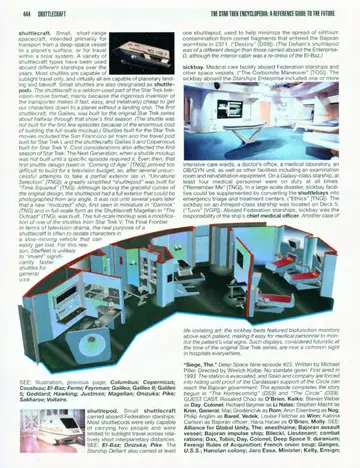
shuttlecraft. Small, short-range one shuttlepod, used to help minimize the spread of silithium spacecraft, intended primarily for contamination from comet fragments that entered the Bajoran to a planet's surface, or for travel “=m, was of a different design than those camied aboard the Enterprise transport from a deep-space vessel wormhole in 2371. (“Destiny” [DS9)). (The Defiant’s shuttiepod
within a solar system, A variety of CO “Se D, although the interior cabin was a re-dress of the El-Baz) shuttlecraft types have been used - aboard different starships over the sickbay. Medical care facility aboard Federation starships and years. Most shuttles are capable of other space vessels. (“The Corbomite Maneuver” [TOS]). The sublight travel only, and virtually all are capable of planetary land- sickbay aboard the Starships Enterprise included one or more ing and takeoff. Small shuttles are also designated as shuttle- [ T—— tt vision-movie format, mainly because the ingenious invention of 4 _— a pods. The shuttlecraft is a seldom-used part of the Star Trek tele % the transporter makes it fast, easy, and (relatively) cheap to get — rr - E our characters down to a planet without a landing ship. The first " — ey he | shuttlecraft, the Galileo, was built for the original Star Trek series | TE about halfway through that show's first season. (The shuttle was 3 not built for the first few episodes because of the enormous cost > — of building the full-scale mockup.) Shuttles built for the Star Trek | movies included the San Francisco air tram and the travel pod built for Star Trek |, and the shuttlecrafts Galileo 5 and Copernicus — built for Star Trek V. Cost considerations also affected the first season of Star Trek: The Next Generation, when a shuttle mockup was not built until a specific episode required it. Even then, that first shuttle design (seen in “Coming of Age” [TNG]) proved too intensive-care wards, a doctor's office, a medical laboratory, an difficult to build for a television budget, so, after several unsuc OB/GYN unit, as well as other facilities including an examination cessful attempts to fake a partial exterior (as in “Unnatural room and rehabilitation equipment. On a Galaxy-class starship, at Selection” [TNG]), a greatly simplified “shuttlepod” was built for least four medical personnel were on duty at all times “Time Squared” (TNG). Although lacking the graceful curves of ~~ (*Remember Me" [TNG]). In a large-scale disaster, sickbay facili the original design, the shuttlepod had a full exterior that could be ties could be supplemented by converting the shuttlebays into photographed from any angle. It was not until several years later emergency triage and treatment centers. (“Ethics"” [TNG]). The that a new “midsized” ship, first seen in miniature in “Darmok” sickbay on an Intrepid-class starship was located on Deck 5 (TNG) and in full-scale form as the Shuttlecraft Magellan in “The (“Tuvix" [VGR]). Aboard Federation starships, sickbay was the Outcast” (TNG), was built. This full-scale mockup was a modifica- responsibility of the ship's chief medical officer. Another case of tion of one of the shuttles from Star Trek V. The Final Frontier. In terms of television drama, the real purpose of a 4 = shuttlecraft is often to isolate characters in b- y . a slow-moving vehicle that can - easily get lost. For this rea- 2 /] son, Starfleet is unlikely | _" { to “invent” signifi- ka jo) “Ly cantly faster oo” i | f y shuttles for “iw 8 & CTL general ul | « - At a ol pfs - ) : | 4 £3 = oe 5 - > «BS | -—-— v | -_ a ) - > Fr fm . g man = Es > : —tT life imitating art: the sickbay beds featured biofunction monitors above each patient, making it easy for medical personnel to monitor the patient's vital signs. Such displays, considered futuristic at the time of the original Star Trek series, are now a common sight in hospitals everywhere.
“Siege, The.” Deep Space Nine episode #23. Written by Michael . 5 Piller. Directed by Winrich Kolbe. No stardate given. First aired in 1993. The station is evacuated, and Sisko and company are forced SEE: lllustration, previous page; Columbus; Copernicus; into hiding until proof of the Cardassian support of the Circle can Cousteau; El-Baz; Fermi; Feynman; Galileo; Galileo ll; Galileo reach the Bajoran government. This episode completes the story 5; Goddard; Hawking; Justman; Magellan; Onizuka; Pike; begun in “The Homecoming” (DS9) and “The Circle" (DSS). Sakharov; Voltaire. GUEST CAST: Rosalind Chao as O'Brien, Keiko; Steven Weber as Day, Colonel; Richard Beymer as Li Nalas: Stephen Macht as 5 “hw | | shuttlepod. Small shuttlecraft Krim, General, Mac Grodénchik as Rom; Aron Eisenberg as Nog; NI 9 carried aboard Federation starships Philip Anglim as Bareil, Vedek; Louise Fletcher as Winn; Katrina Vv Q Lal A \ Most shuttlepods were only capable Carlson as Bajoran officer; Hana Hatae as O'Brien, Molly. SEE. es I S = of carrying two people and were Alliance for Global Unity, The; anesthizine; Bajoran assault - . limited to sublight travel across rela- vessel; Bajoran impulse ship; Bilecki, Lieutenant; combat ~ | tively short interplanetary distances. rations; Dax, Tobin; Day, Colonel; Deep Space 9; duranium; SEE: El-Baz; Onizuka; Pike. The Ferengi Rules of Acquisition; French onion soup; Ganges, i Starship Defiant also carried at least U.S.S.; Hanolan colony; Jaro Essa, Minister; Kelly, Ensign;